Compressed biogas plants
Upgrade biogas to Bio-CNG for vehicles and city gas.
- SATAT plants
- City gas injection
- Vehicle fuel
RESEARCH PARTNERSHIP / 03

Rispri Labs delivers modular water scrubbers, developed with IIT Bombay, that strip CO₂ from raw biogas at near-atmospheric pressure. A lower-cost route to Bio-CNG and compressed biogas for plants of every size.
IIT Bombay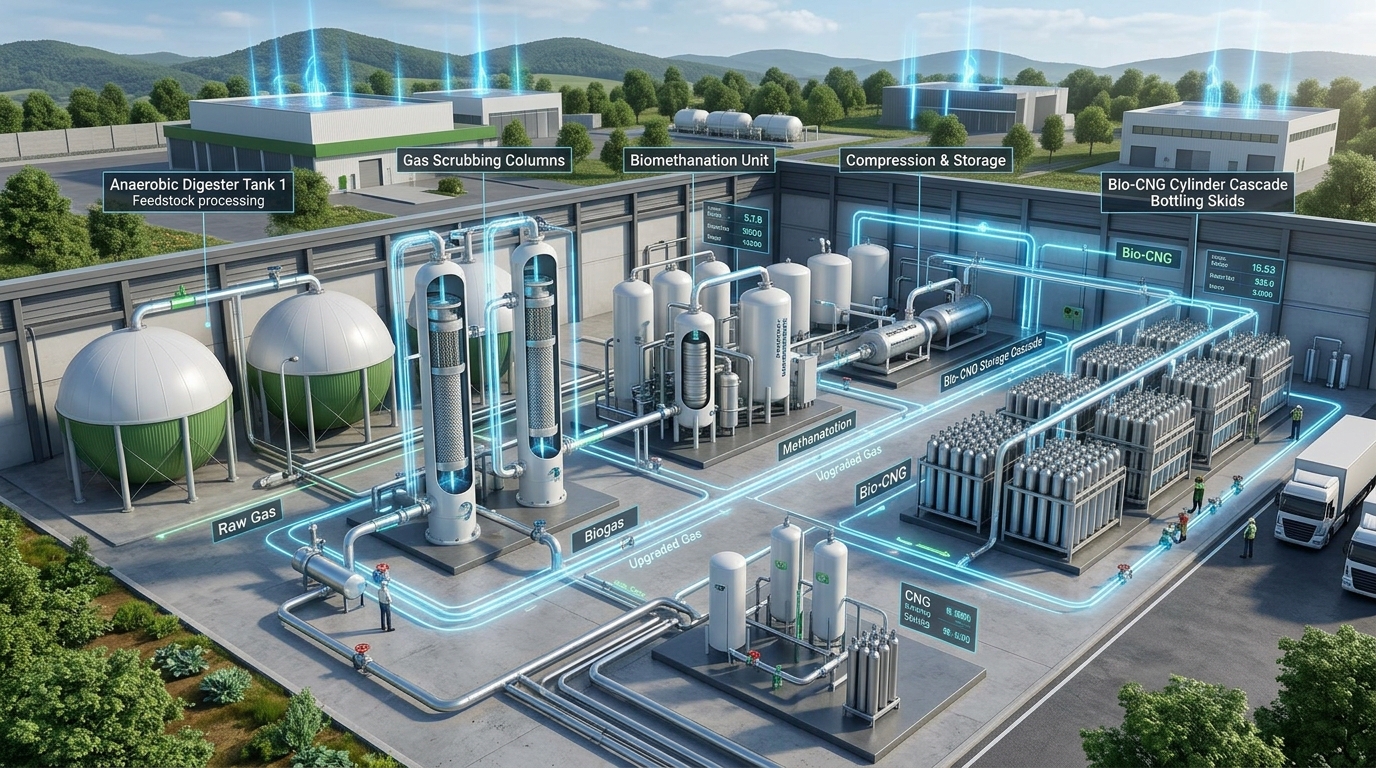
What it means for you
Raw biogas is cleaned at normal air pressure before any compression.
No amines, no caustic, no chemicals to buy or handle.
Modular units sized for a gaushala, dairy or STP digester.
Performance
Conventional water scrubbers compress biogas to several bar before they can remove CO₂, and chemical scrubbers need amines or caustic. A rotating-disk contactor does the job with water at near-atmospheric pressure.
Figures are from the research team's field validation in operating conditions. Performance on your stream is confirmed in our laboratory before design.
Challenge and response
Water scrubbers compress raw biogas to several bar before upgrading.
Scrub at near-atmospheric pressure and compress only the clean methane.
Amine and caustic scrubbers add chemical cost and handling risk.
Plain water absorbs the CO₂; no chemicals are dosed.
Small digesters cannot justify a large upgrading plant.
Modular units match the gas flow of dairies, gaushalas and STPs.
High power use eats into Bio-CNG margins.
Low pump head and very low pressure drop keep running power down.
How it works
Raw biogas flows across disks wetted with a thin film of water.
CO₂ dissolves into the water far faster than methane does.
Methane-rich gas moves on for drying and compression to Bio-CNG.
The water releases its CO₂ in air and is circulated again.
Use cases
Upgrade biogas to Bio-CNG for vehicles and city gas.
Turn cattle-dung biogas into saleable fuel.
Upgrade sludge digester gas for on-site use or sale.
Upgrade gas from press mud, distillery and food waste.
Upgrade gas from organic fraction biomethanation.
Replace LPG, diesel or furnace oil on site.
Comparison
| Factor | Pressurised water or amine scrubber | Rispri solution |
|---|---|---|
| Scrubbing pressure | Several bar; raw gas compressed first | Near-atmospheric |
| Chemicals | Amines or caustic in chemical scrubbers | Water only |
| Scale | Economic mainly at large flows | Modular; suits small and mid-size digesters |
| Energy | Compressor on the full raw-gas flow | Low-head pump; compress only the upgraded gas |
| Operation | Skilled operation of pressure vessels | Simple, low-pressure equipment |
Standards and regulations
We design each system to meet your consent conditions and the regulations for your sector, and our laboratory reports against them.
Industries served
Why Rispri
Built on patented and peer-reviewed research from our partnership with IIT Bombay.
Our accredited laboratory characterises your water or waste before design and verifies results after.
The team that builds ETPs, STPs and ZLD plants across India takes each solution from pilot to full scale.
Design, supply, installation, commissioning, operation and testing under one contract.
Questions
The rotating disks create a very large, constantly renewed water film. That gives the gas enough contact time with water to absorb CO₂ at near-atmospheric pressure, instead of relying on high pressure to push it into solution.
Units are modular, so they suit small and mid-size digesters at dairies, gaushalas and STPs as well as larger CBG plants, which usually find conventional upgrading hard to justify.
No. Water absorbs the CO₂ and is regenerated in air for reuse.
The water-based scrubber has reached TRL 8, which means the system has been proven in operating conditions.
Yes. We design and build complete waste-to-energy plants, from feed handling and digestion to upgrading and testing.
Research partnerships
THE NEXT STEP
Send us a sample or tell us about your site. We will test it, recommend a configuration and set up a pilot.
Request a pilot