INDUSTRIES / CETPS AND INDUSTRIAL ESTATES
Common effluent treatment plants
that every member can rely on.
A CETP is only as good as the effluent its members send it. We help CETP societies and industrial estates run, monitor and upgrade their plants: inlet monitoring, member-unit testing in our NABL-accredited laboratory, O&M, tertiary and ZLD upgrades, chemicals and safe drain cleaning.
In short
What a CETP is and how it works.
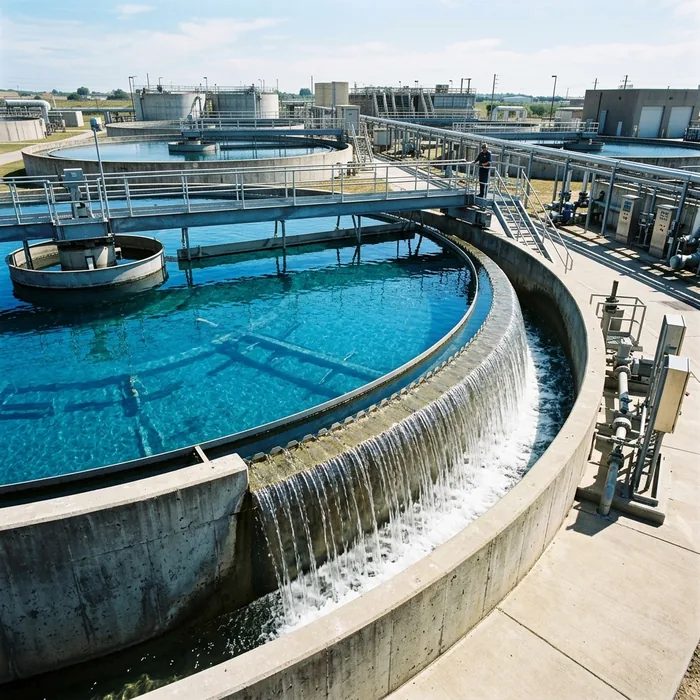
A common effluent treatment plant (CETP) is a shared plant that treats the industrial wastewater of many small and medium units in an industrial estate or cluster, which could not each afford or run their own full ETP. Member units pre-treat their effluent to agreed inlet norms, send it by pipeline or tanker, and share the cost in proportion to volume and pollution load. The CETP then provides equalisation, physico-chemical treatment, biological treatment and tertiary treatment, and in many clusters now recovers water by RO and evaporation (ZLD). In India, CETPs operate under a consent from the State Pollution Control Board and must meet the CETP discharge standards notified by MoEF&CC in 2016.
- 2016
- Year MoEF&CC notified dedicated discharge standards for CETPs
- 30mg/L
- BOD limit for CETP discharge to inland surface water under the 2016 standards
- 250mg/L
- COD limit for CETP discharge to inland surface water under the 2016 standards
- NABL
- Accredited laboratory for member-unit, inlet and outlet testing
Members and effluent
Who uses a CETP, and what do they send it?
CETPs were promoted in India from the early 1990s so that clusters of small-scale industries, which make up a large share of industrial pollution, could treat effluent collectively. A CETP is usually owned by a society, company or special purpose vehicle of member units, sometimes with the state industrial development corporation, and run by its own staff or an O&M contractor.
Typical member industries
- Textile dyeing and printing: large flows, colour, high TDS from salt and alkali, high temperature.
- Chemicals, dyes and intermediates, pharmaceuticals: high COD that bacteria break down slowly, solvents, sometimes toxic compounds.
- Electroplating and engineering: heavy metals (chromium, nickel, zinc, copper), cyanide, acids.
- Tanneries: chromium, sulphide, salt, high solids.
- Food processing, dairies and slaughterhouses: high BOD and fats; easy to treat biologically but heavy in load.
- Mixed estates: many sectors at once, which makes the effluent vary hour by hour.
Inlet norms and pre-treatment
Each member signs up to inlet norms set by the CETP and approved by the SPCB. They usually limit pH, oil and grease, suspended solids, heavy metals, cyanide, phenols, temperature and sometimes COD and TDS, so that the common plant receives only what its process can treat. Typical pre-treatment at the member's gate includes neutralisation, oil and grease traps, settling, and chromium reduction or metal precipitation for plating units. Members whose effluent cannot meet the norms need their own ETP or source treatment.
| Parameter | Typical CETP inlet range | Why it matters |
|---|---|---|
| pH | Swings between 2 and 12 if members do not neutralise | Acid or alkaline shocks kill the biological stage and corrode pipes |
| COD | 1,000 to 5,000 mg/L, higher in chemical clusters | Sets the size of biological treatment; slowly biodegradable COD often decides compliance |
| BOD : COD ratio | Often 0.2 to 0.4 | A low ratio means much of the load resists bacteria and needs advanced oxidation or adsorption |
| TDS | 2,000 to 15,000 mg/L | Biology cannot remove dissolved salts; high TDS drives the move to RO and evaporation |
| Suspended solids | 200 to 1,000 mg/L | Determines chemical dose and sludge volume |
| Heavy metals | Varies with plating, tannery and dye members | Toxic to bacteria and to the river; ends up in the sludge |
| Colour | Strong in textile and dye clusters | A visible failure even when BOD and COD comply |
Standards and rules
What standards must a CETP meet?
In January 2016 MoEF&CC notified revised discharge standards for CETPs under the Environment (Protection) Rules, 1986, with separate values for discharge into inland surface water, onto land for irrigation and into marine coastal areas, and a list of heavy metals and toxic parameters. The inlet quality is left to the CETP and the SPCB, to suit the members. The core values for discharge to inland surface water are shown below; heavy metal and other limits apply in addition, and many consents now go further and require ZLD.
| Parameter | Limit |
|---|---|
| BOD (3 days at 27 °C) | 30 |
| COD | 250 |
| Total suspended solids | 100 |
| Oil and grease | 10 |
| Ammoniacal nitrogen | 50 |
| Heavy metals, cyanide, phenols, sulphide, fluoride | Individual limits in the notification |
Treatment
How a CETP treats mixed industrial effluent.
A CETP must handle effluent that changes in strength and type through the day. Its design rests on generous equalisation, robust physico-chemical treatment and a biological stage protected from shocks.
| Stage | What happens |
|---|---|
| 1. Member pre-treatment and conveyance | Each unit neutralises and pre-treats to inlet norms; effluent travels by dedicated pipeline (better, traceable) or by tanker with a logbook. |
| 2. Inlet screening, monitoring and receiving | Screens, grit removal and an inlet monitoring point. Tanker loads are tested before unloading and suspect loads diverted to a holding tank. |
| 3. Equalisation | A large mixed tank (often 12 to 24 hours of flow) smooths variations in pH, COD and toxicity between members. |
| 4. Neutralisation and physico-chemical treatment | pH correction, coagulation with lime, alum or ferric salts and polymer, and settling in a primary clarifier remove suspended solids, metals and part of the COD and colour. |
| 5. Biological treatment | Extended aeration, MBBR or a two-stage biological system remove biodegradable organics. An anaerobic stage can precede it for high-strength food or chemical effluents. |
| 6. Secondary clarification | Separates biomass; part is returned, the rest wasted to the sludge line. |
| 7. Tertiary treatment | Pressure sand and activated carbon filters; advanced oxidation (ozone or Fenton) where COD or colour does not respond to biology. |
| 8. Recovery (where required) | Ultrafiltration and RO recover water for members; the RO reject goes to evaporation and the salts are dried. |
| 9. Sludge handling | Thickening, filter press or centrifuge dewatering, drying and dispatch to a TSDF. |
| Upgrade | Best for | Watch-outs |
|---|---|---|
| MBBR media in existing aeration tanks | Overloaded biology, more members joining | Retention screens and aeration capacity |
| Advanced oxidation (ozone, Fenton) | Residual COD and colour from dyes and chemicals | Chemical and power cost; Fenton adds iron sludge |
| UF + RO water recovery | Clusters with water shortage or a no-discharge consent | Needs very good pre-treatment; RO reject must be managed |
| Evaporation of RO reject | ZLD clusters | High energy cost of conventional evaporators, salt disposal |
| Inlet and member monitoring | Every CETP with shock loads or disputes over charges | Needs agreed rules and follow-up action |
Our NABL-accredited laboratory runs member-unit sampling campaigns, inlet and outlet profiles over 24 hours, treatability tests and heavy metal analysis, so charges, warnings and upgrades rest on data members accept.
Upgrade, reuse and ZLD
Can a CETP recycle water or move to zero liquid discharge?
Yes, and in water-stressed clusters, particularly textile and chemical clusters, boards increasingly require it. A CETP-based ZLD scheme recovers water through UF and RO and returns it to members as process water, while the RO reject is concentrated and evaporated, and the salt is dried.
What makes CETP ZLD hard
- Mixed salts and organics: salt from many members carries organic contamination, so recovered salt is rarely clean enough to reuse without further treatment.
- Energy: conventional multiple-effect evaporators use a great deal of steam or power per kilolitre evaporated.
- Membrane fouling: poor upstream treatment shortens RO membrane life.
Lower-cost evaporation
Rispri's non-thermal RCD wastewater vaporiser evaporates RO reject at roughly 80% lower evaporation cost than a multiple-effect evaporator, and forward osmosis can concentrate reject further before evaporation. Both are piloted on the client's own stream first. See non-thermal evaporators and RO reject management.
Recovering resources
Clusters with plating or dye members can recover metals and colour at source, which reduces the load on the CETP. See heavy metal recovery and textile dye effluent treatment.
Cost
What does it cost to run or upgrade a CETP?
CETP costs depend on capacity, member mix, outlet standard and whether the plant must achieve ZLD. These indicative figures help with first budgets.
| Item | Typical scope | Indicative cost* |
|---|---|---|
| Performance audit and testing campaign | 24-hour inlet and outlet profiles, member sampling, unit-by-unit review | ₹3 to 15 lakh |
| Biological upgrade (MBBR retrofit) | Media, screens and aeration in existing tanks, 1 to 5 MLD | ₹50 lakh to ₹4 crore |
| Tertiary upgrade | Filters, advanced oxidation, disinfection | ₹40 lakh to ₹3 crore |
| UF + RO water recovery | Per MLD of feed | ₹3 to 6 crore per MLD |
| Annual O&M contract | Staff, routine maintenance, lab tests (chemicals and power usually separate) | ₹25 lakh to ₹1.5 crore a year |
*Indicative 2026 ranges excluding land, civil works unless stated, taxes and evaporator systems. Running cost of a conventional CETP is commonly in the range of ₹30 to 100 per kilolitre and several times higher with ZLD, mostly chemicals, power, sludge disposal and evaporation. We give firm figures after a testing campaign and site review.
What drives cost
- Member mix and COD, TDS and metals load
- Outlet standard or ZLD requirement
- Sludge volume and TSDF charges
- Evaporation energy
- Condition of existing tanks and machinery
Fair charging between members
- Flow meters at every member outlet
- Charges by volume and load (COD, TDS, metals)
- Penalties for breaching inlet norms
- Regular independent sampling of members
- Transparent monthly reports
We audit the plant and the members, stabilise operation, upgrade treatment stages and take over O&M with monthly NABL-accredited reports.
Troubleshooting
Common CETP problems, and how we fix them.
- 01The problem
Toxic or acid shock loads kill the biological stage.
What we doOnline pH and conductivity at the inlet, a diversion tank for suspect loads, testing of tankers before unloading, and re-seeding with lab support.
- 02The problem
Some members do not pre-treat, and nobody can prove who.
What we doMember flow meters and surprise sampling by an independent NABL-accredited laboratory, with results shared with the society and, where needed, the SPCB.
- 03The problem
COD and colour stay above limits even after biology.
What we doTreatability tests on the residual COD, then targeted advanced oxidation, adsorption or source treatment at the members responsible.
- 04The problem
The plant is overloaded as the estate grows.
What we doMBBR retrofit and better equalisation within existing tanks, and water-saving at member units to cut volume.
- 05The problem
Sludge piles up on site waiting for TSDF dispatch.
What we doOptimise coagulant and polymer dose to cut sludge volume, improve dewatering and dry the cake to reduce weight before dispatch.
- 06The problem
OCEMS data shows exceedances or gaps, and the board asks questions.
What we doCalibrate and maintain analysers, check them against laboratory results, and fix the process issue behind the readings.
What we offer
Services for CETPs and industrial estates.
Member-unit and inlet testing
Sampling campaigns, 24-hour profiles, treatability and heavy metal tests in our NABL-accredited lab.
Testing →OCEMS and inlet monitoring
Outlet OCEMS, member flow meters and inlet pH and conductivity alarms with dashboards.
Smart monitoring →Upgrades and O&M
Biological and tertiary upgrades, and long-term operation with trained staff.
ETP and CETP plants →Treatment chemicals
Coagulants, polymers, neutralising agents, antiscalants and RO cleaning chemicals.
Chemicals →Drain and sewer safety
No-entry cleaning of conveyance lines and portable toxic gas detectors.
Sewer safety →Buying guide
What to ask a CETP operator or upgrade contractor.
Use this list with any supplier, including us.
- Is the proposal based on measured inlet data, including 24-hour profiles and member sampling?
- Which outlet values are guaranteed, and under what inlet conditions?
- How will shock loads be detected and handled before they reach the biology?
- How will members be monitored and charged fairly by volume and load?
- What are the chemical, power and sludge costs per kilolitre?
- If ZLD is required, what is the energy cost of evaporation, and where will the salt go?
- Who maintains OCEMS and checks it against laboratory results?
- Is the testing laboratory NABL-accredited and independent of the members?
Why Rispri
Laboratory, engineering and chemicals for the whole cluster.
Our own NABL lab
Independent testing of members, inlet and outlet, so decisions rest on data the society can stand behind.
Engineering since 1999
1,498+ plants and turnkey projects and 499+ clients across industries and cities.
Chemicals in house
Coagulants, polymers, antiscalants and cleaning chemicals from our own catalogue.
Low-energy ZLD options
Field-tested non-thermal evaporation and RO reject concentration. We work in collaboration with IIT Bombay, IIT Kharagpur and ICT Mumbai.
Questions
Common effluent treatment plant FAQs.
What is a common effluent treatment plant?
A CETP is a shared treatment plant that treats the industrial effluent of many small and medium units in an industrial estate or cluster. Members pre-treat to agreed inlet norms, and costs are shared by volume and pollution load.
Who should join a CETP?
Small and medium units whose effluent volume is too small to justify their own full ETP, and whose effluent is compatible with the CETP's process. Units with unusual or highly toxic effluent may still need their own treatment.
What are the CETP discharge standards in India?
MoEF&CC notified CETP standards in 2016. For discharge into inland surface water, core limits include BOD 30 mg/L, COD 250 mg/L, TSS 100 mg/L and oil and grease 10 mg/L, plus individual limits for heavy metals and toxic parameters. Your consent may be stricter or require ZLD.
What are CETP inlet norms?
Inlet norms are the limits each member must meet before sending effluent to the CETP, typically for pH, oil and grease, suspended solids, heavy metals, cyanide and temperature. They are set by the CETP and approved by the SPCB to protect the common plant.
What pre-treatment do member units need?
Usually neutralisation, oil and grease removal and settling, plus metal precipitation or chromium reduction for plating and tannery units. The aim is to remove what the CETP cannot treat or what would upset its biology.
Why do CETPs fail to meet standards?
The usual causes are shock loads from members who do not pre-treat, overloading as estates grow, residual COD that bacteria cannot break down, poor sludge handling and under-maintained equipment. A testing campaign usually shows which applies.
Is online monitoring mandatory for CETPs?
CPCB directions require CETPs to install online continuous effluent monitoring with data sent to the SPCB and CPCB. Monitoring at the inlet and at member outlets is not always mandatory but is the best way to control shock loads.
Can a CETP achieve zero liquid discharge?
Yes. Water is recovered through UF and RO and returned to members, and RO reject is evaporated with the salts dried. Energy for evaporation is the largest running cost, which is why low-energy evaporation matters.
How are CETP charges shared among members?
Most CETPs charge by volume, measured by flow meters, and by pollution load such as COD or TDS, with penalties for breaching inlet norms. Fair, measured charging reduces disputes and improves compliance.
What happens to CETP sludge?
Chemical sludge is usually hazardous waste under the Hazardous and Other Wastes Rules, 2016. It is dewatered, stored under cover and sent to an authorised TSDF.
Is government funding available for CETPs?
Central schemes from the environment, MSME and textile ministries have supported CETPs, usually with state and member contributions. Terms change, so check current scheme guidelines with your state industries department.
Do you operate CETPs?
Yes. We offer O&M with trained staff, chemicals, OCEMS upkeep and monthly NABL-accredited reports, along with audits and upgrades for plants built by others.
Related