
SOLUTIONS / EPC AND O&M PROJECTS
Water treatment EPC contractor
with one team accountable from design to operation.
We take water and wastewater projects from feasibility to a running plant under one contract: engineering, procurement, construction, commissioning and long-term operation and maintenance. Outlet guarantees are based on treatability tests in our own NABL-accredited laboratory.
In short
What an EPC contract for a water plant means.
An EPC contract is one where a single contractor takes responsibility for the engineering (design), procurement (buying equipment and materials) and construction of a plant, then commissions it and hands it over working, usually for a fixed price and date. For a water or wastewater plant, the contractor also guarantees performance: that the plant treats the agreed flow and that the outlet meets the agreed quality, such as the limits in the owner's pollution control board consent. An O&M contract then pays a contractor to run the plant and keep it compliant for an agreed number of years.
- 1,498+
- Plants and turnkey projects since 1999
- 72hours
- Performance test run before handover
- 3phases
- FEED, detailed engineering and procurement, site execution
- NABL
- Accredited laboratory that verifies guaranteed outlet values
Contract models
EPC, design-build, equipment supply or BOOT: what is the difference?
The contract model decides who carries which risk. The more of the project one contractor takes on, the simpler it is for the owner, and the more the contractor prices in for the risk it carries.
Equipment supply means you buy the plant items, such as an RO skid, blowers or a filter press. You or another contractor design the system, build the tanks, install and connect everything. Cheapest upfront, but if the plant fails its limits, each supplier can point at the others.
Design-build (DB) means one party designs and builds to meet a performance requirement you set. In water projects, design-build and EPC are often used to mean much the same thing. The difference is mostly in how the price and risk are fixed: a strict EPC (often called lump-sum turnkey, LSTK) fixes price and completion date and puts nearly all design and construction risk on the contractor.
EPCM (engineering, procurement and construction management) is different: the contractor designs and manages the project, but the owner places the equipment and construction contracts directly and carries more cost risk.
DBO (design-build-operate) adds a period of operation by the same contractor, which is common in municipal sewage and water supply projects. BOOT or DBOOT (design, build, own, operate and transfer) goes further: the contractor also finances and owns the plant for a set period, recovers its money from water tariffs or fees, and then transfers the plant to the owner.
HAM (hybrid annuity model) is a public-sector model used in India for sewage treatment projects under the Namami Gange programme. The government pays part of the capital cost during construction and the rest, with O&M payments, as annuities over the operating period, which are tied to the plant's performance.
EPC scope and phases
What is included in a water treatment EPC contract?
A complete EPC scope covers five areas of work. Listing them in the contract stops the most common argument on site: whose job a forgotten item was.
| Work area | What it includes | How we deliver it |
|---|---|---|
| Engineering and design | Process design, mass balance, hydraulic profile, layouts, structural design, P&IDs, electrical and control drawings | 3D models and P&IDs, 3D piping clash checks, MCC panel drawings, approved-for-construction (AFC) drawings |
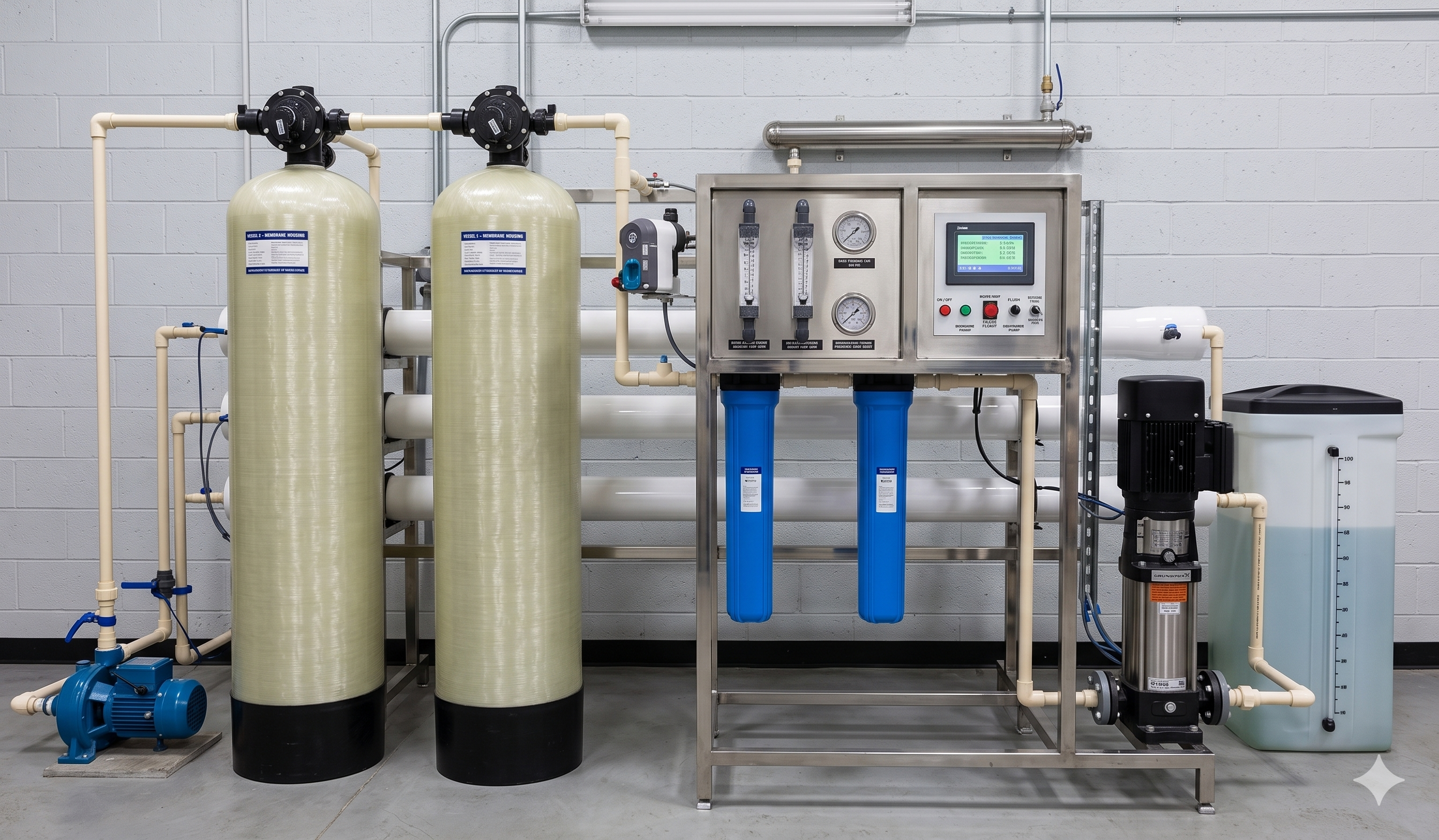
| Procurement | Pumps, blowers, membranes, vessels, valves, instruments, panels and bulk materials; inspection and expediting | Sourcing to OEM specifications, for example Grundfos pumps, Danfoss energy recovery devices, Dow FilmTec membranes and SS316L pressure vessels; skid fabrication with factory acceptance tests (FAT) |
| Civil and mechanical | Tanks, buildings, foundations, equipment erection, piping | RCC water-retaining tanks, skid mounting, SS and HDPE piping |
| Electrical and automation | Power distribution, motor control, PLC/SCADA, instruments, telemetry | Siemens or Schneider PLC panels with touch-screen HMI and cloud telemetry; OCEMS connection where required |
| Commissioning and handover | Pre-commissioning checks, start-up, performance test, training, documents | 72-hour performance run, outlet verified by NABL-accredited tests, operator training, O&M manuals and as-built drawings |
Typical exclusions to check in any EPC offer: land, approach roads, raw power up to the plant panel, statutory fees, soil investigation, and the quality of incoming water or effluent outside the agreed design basis.
- 1
Feasibility and FEED
Site survey, raw water or effluent characterisation in our lab, environmental clearance support and preliminary CAPEX and OPEX estimates. FEED means front-end engineering design: enough design to fix scope and price.
- 2
Detailed engineering and procurement
AFC drawings, OEM equipment orders, skid fabrication in the factory and FAT before dispatch.
- 3
Site erection and commissioning
Civil integration, high-pressure piping, PLC/SCADA commissioning, the 72-hour performance run and CPCB OCEMS telemetry connection.
Most EPC disputes start with an effluent that is stronger than the tender assumed. We test composite samples in our NABL-accredited laboratory and run treatability trials before we commit to a guarantee.
Guarantees
What should an EPC contractor guarantee?
A guarantee is only useful if it says what is measured, how, and what happens if the plant falls short. These are the guarantees a water or wastewater EPC contract normally carries.
| Guarantee | What it promises | How it is proved |
|---|---|---|
| Capacity | The plant treats the design flow (KLD or MLD) continuously | Calibrated flow meters during the performance run |
| Process performance | Outlet quality (BOD, COD, TSS, TDS, etc.) within agreed values, for inlet within the design basis | Composite samples tested by an accredited laboratory during the performance run |
| Recovery | For RO, recycling and ZLD: the share of water recovered as product | Feed, permeate and reject flow totals over the run |
| Consumption | Power, chemical and steam use per cubic metre within agreed values | Energy meters and dosing records |
| Mechanical | Equipment free from defects in design, material and workmanship | Defects liability period, often 12 months or more after handover |
| Completion | Plant ready by an agreed date | Programme milestones; delay damages if missed |
Guarantees are normally backed by a performance bank guarantee, and shortfalls by liquidated damages (pre-agreed compensation), both set as a share of contract value. For EPC contractors we also provide lab-backed process performance guarantees as a sub-contractor, protecting the main contractor from SPCB penalties for non-conforming discharge.
O&M contracts
O&M contracts for ETP, STP and RO plants.
Many plants fail not on design but in operation: an untrained operator, a blower left off at night, a missed chemical delivery. An operation and maintenance (O&M) contract makes one party responsible for keeping the plant running and compliant.
| Model | What the contractor does | What the owner still does | Best for |
|---|---|---|---|
| Operator supply | Provides trained operators per shift | Chemicals, spares, repairs, compliance | Owners with a strong in-house engineering team |
| AMC (non-comprehensive) | Scheduled servicing and breakdown visits | Daily operation, spares, chemicals | Small, simple plants |
| Comprehensive AMC (CAMC) | Servicing plus spares and repairs | Daily operation, chemicals | RO, softener and filtration plants |
| Full O&M | Operation, maintenance, chemicals, routine spares, lab testing and compliance reports | Pays power and a monthly fee; major capital replacements as agreed | ETPs, STPs and ZLD plants where compliance is critical |
| Performance-based O&M | As full O&M, with payment linked to KPIs | Monitors KPIs and pays accordingly | Municipal plants, DBO and HAM projects, large industrial plants |
KPIs worth writing in
- Outlet quality: share of samples within consent limits
- Plant availability (uptime)
- Volume treated and recovered
- Power and chemical use per m³
- Membrane cleaning interval and life
- Response time to breakdowns
What we include
- Trained operators and a site engineer
- 24/7 operation with remote telemetry
- Optimised chemical dosage
- Genuine spares and preventive maintenance
- Monthly NABL-accredited test reports
- Help with board inspections and filings
Contract terms to agree
- Inlet design basis the KPIs depend on
- Who pays power, chemicals and sludge disposal
- Which repairs are routine and which are capital
- Penalty and bonus rules
- Price escalation each year
- Handback condition at the end
We take over ETPs, STPs and RO plants, including ones built by others: audit, fix, then operate under an O&M contract with monthly lab reports and chemicals and spares from our own catalogue.
Codes and permits
Contracts, codes and permits we work to.
An EPC project is judged by the contract, the engineering codes and the environmental permits that apply to it.
| Area | Typical reference |
|---|---|
| Contract form | FIDIC-style conditions with clear roles, risk sharing and payment milestones (FIDIC publishes separate books for employer-designed, design-build, EPC turnkey and design-build-operate works) |
| Management systems | ISO 9001 (quality), ISO 14001 (environment) and ISO 45001 (health and safety) on every site |
| Pressure vessels and piping | ASME and IS codes |
| Water-retaining structures | IS 456 (plain and reinforced concrete) and IS 3370 (concrete structures for storing liquids) |
| Discharge and consent (India) | Water Act, 1974 consents (CTE/CTO); Environment (Protection) Rules, 1986 standards; MoEF&CC STP notification, 2017 |
| Monitoring and groundwater | CPCB OCEMS directions; CGWA guidelines, 2020 |
| Projects abroad | Local environmental permits and discharge approvals in each country |
Pricing
How is an EPC or O&M contract priced?
The price depends on the pricing model as much as on the plant. Know which one you are being offered.
| Pricing model | How it works | Who carries cost risk |
|---|---|---|
| Lump sum | One fixed price for a defined scope, paid against milestones | Contractor, within the agreed scope |
| Item rate / BOQ | Rates for each item, paid on measured quantities | Owner, for quantity changes |
| Cost plus fee | Actual cost plus an agreed fee or percentage | Owner |
| O&M monthly fee | Fixed fee per month, sometimes plus a rate per m³ treated | Contractor for labour and routine items; as agreed for power and chemicals |
| Annuity or tariff (HAM, BOOT) | Payments over many years, linked to performance | Shared; contractor carries financing risk |
Where EPC money goes
On a typical civil-based ETP or STP, equipment, civil works and electrical and automation are the three biggest blocks. Their shares change with the technology: a membrane or ZLD plant is equipment-heavy, a large activated sludge plant is civil-heavy.
Indicative plant costs
A conventional biological ETP of 100 KLD costs roughly ₹25 to 60 lakh for equipment and installation, excluding civil works and land. Our ETP and ZLD guides give more ranges.
What raises the price
- Unclear design basis, so the contractor adds margin
- Strict performance guarantees and high damages caps
- Remote sites and short programmes
- Imported equipment and currency exposure
- Long O&M periods with fixed prices
All figures are indicative and exclude taxes. We price EPC and O&M only after testing the water or effluent and visiting the site.
Risks
EPC project risks, and how we manage them.
- 01The risk
Design, supply and civil works are split across many contracts, and nobody owns the outcome.
How we manage itSingle-point EPC with one programme, one budget and one warranty.
- 02The risk
The plant misses its guaranteed output after handover.
How we manage itGuarantees based on treatability data from our lab, and a 72-hour performance run with accredited test results before handover.
- 03The risk
Equipment arrives late or does not match the specification.
How we manage itStage-gated procurement, skids built and tested in the factory (FAT) before dispatch, and long-lead items ordered first.
- 04The risk
Local permits and standards differ in every state and country.
How we manage itPermitting support, consent and CGWA documentation, and design to local codes and regulators.
- 05The risk
Skilled operators are hard to find, and performance drops after the contractor leaves.
How we manage itHands-on operator training, and long-term O&M contracts with remote telemetry so problems are seen early.
Where it fits
Who we deliver EPC and O&M projects for.
Municipal utilities
Sewage treatment, water supply and reuse plants, including DBO-style contracts with long operation periods.
STP guide →Industrial parks and factories
ETPs, CETP upgrades, recycling and ZLD under one contract.
ETP, STP and ZLD →Hotels and resorts
STPs with reuse, softening, pools and desalination for island and coastal sites.
Hotels guide →Oil, gas and power
DM and RO make-up water, cooling water treatment and oily wastewater.
Oily wastewater →Real estate and campuses
Packaged STPs, water treatment and smart metering for townships and institutions.
Smart water →Civil and EPC contractors
Process design, P&IDs and cost estimates for tender bids, and sub-contracting of the treatment, chemical and membrane packages.
Process design →Buying guide
What to ask a water treatment EPC contractor.
Use this list with any bidder, including us.
- What design basis is your guarantee based on? Ask how the inlet was tested and over what period.
- Exactly what is in and out of scope? Civil works, power supply, approvals, sludge disposal, spares.
- How will performance be tested? Duration of the run, who samples, which laboratory.
- What happens if guarantees are missed? Rectification period, damages and their cap.
- Who is the project manager, and who is on site? Names and experience, not just a company profile.
- What are the running costs? Power, chemicals and consumables per m³, guaranteed where possible.
- Will you operate the plant after handover? On what terms, KPIs and price escalation.
- Can we visit a plant you built and still operate? The best evidence of a contractor's work.
Why Rispri
One accountable partner, from lab bench to running plant.
Lab and engineering under one roof
Our NABL-accredited laboratory tests the water, sizes the process and verifies results after start-up. No hand-offs between vendors.
1,498+ plants and projects
Designs proven on real sites since 1999, from compact STPs for hotels to industrial ETP, RO and ZLD systems.
Compliance built in
We design to CPCB and SPCB limits with margin, and plan for OCEMS, CGWA and reuse rules from the first drawing.
We stay after handover
Chemicals, genuine spares, operator training and O&M contracts keep the plant performing for years.
Questions
EPC and O&M FAQs.
What is an EPC contract in water treatment?
It is a contract in which one company handles the engineering, procurement and construction of a water or wastewater plant, commissions it and hands it over working. The contractor normally guarantees the plant's capacity and outlet quality for a fixed price and completion date.
What is the difference between EPC and EPCM?
Under EPC, the contractor buys and builds everything itself and carries the cost and schedule risk. Under EPCM, the contractor designs and manages the project, but the owner signs the equipment and construction contracts directly and carries more of the cost risk.
Is turnkey the same as EPC?
Mostly, yes. A turnkey or lump-sum turnkey (LSTK) contract is a form of EPC in which the contractor delivers a complete, working plant for a fixed price. The term stresses that the owner only has to "turn the key".
What is BOOT or DBOOT in water projects?
In a design, build, own, operate and transfer contract, the contractor finances and owns the plant for an agreed period, recovers its investment through fees or tariffs, and then hands the plant over to the owner. It suits owners who want to avoid upfront capital.
What is the hybrid annuity model (HAM) for STPs?
HAM is a public-private model used in India for sewage treatment projects, notably under the Namami Gange programme. Part of the capital cost is paid during construction and the rest, together with O&M payments, is paid as annuities over the operating period, linked to performance.
What performance guarantees should an EPC contract include?
At least capacity, outlet quality against the agreed limits, water recovery for RO or ZLD, power and chemical use per m³, mechanical defects liability and completion date. Each should say how it will be tested and what happens if it is missed.
How long does an EPC water treatment project take?
Skid-mounted and containerised plants can be delivered in weeks to a few months. Large civil-based ETPs, STPs and ZLD plants usually take several months to more than a year from design approval to handover, plus stabilisation time for biological processes.
What is included in an O&M contract for an ETP or STP?
A full O&M contract usually covers operators, preventive and breakdown maintenance, chemicals, routine spares, daily and monthly testing, log books and compliance reports. Power, major replacements and sludge disposal are often handled as separate items, so check the scope.
What is the difference between O&M and AMC?
Under O&M, the contractor runs the plant every day and is responsible for its performance. Under an AMC, the contractor services the plant and attends breakdowns, but your own staff operate it. A comprehensive AMC also includes spares.
Which KPIs should an O&M contract use?
Useful KPIs are the share of outlet samples within consent limits, plant availability, volume treated and recovered, power and chemicals per m³, and response time to breakdowns. KPIs should be measured from meters and accredited lab results, not estimates.
Do you work on EPC projects outside India?
Yes. We deliver turnkey containerised and skid-mounted water treatment plants, desalination units and ZLD systems in South Asia, Africa and the Middle East.
Can you work as a sub-contractor to our EPC company?
Yes. We provide process design, P&IDs and cost estimates for tender bids, execute the treatment, chemical and membrane packages, and give lab-backed process performance guarantees to the main contractor.
Related