
SOLUTIONS / SEWAGE TREATMENT PLANT
Sewage treatment plants (STP)
that run quietly and pay back in water.
We design, build and operate sewage treatment plants for apartments, townships, hotels, hospitals, institutions and factories. Each plant is sized on your real flow, meets your board's outlet standard and gives you clean water for flushing, gardening and cooling towers.
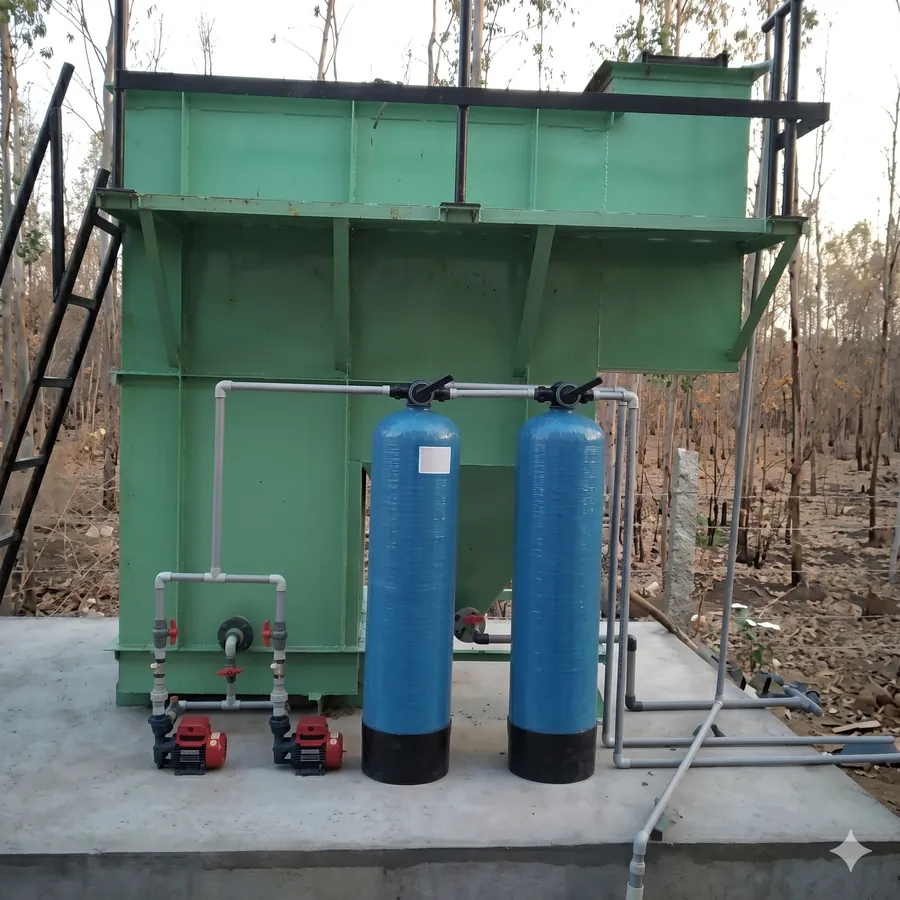
In short
What a sewage treatment plant does.
A sewage treatment plant (STP) is a plant that cleans domestic wastewater from toilets, kitchens, bathrooms and laundries so it can be safely discharged or reused. It works in steps: screening removes solids, an equalisation tank evens out the flow, bacteria in an aerated tank (MBBR, SBR, MBR or activated sludge) eat the organic matter, a clarifier settles them out, and filters plus chlorine or UV polish and disinfect the water. Under India's MoEF&CC STP standards of 2017, treated sewage must have a BOD of 30 mg/L or less (20 mg/L in metro cities and most state capitals), and many boards now ask for stricter values.
- 135L/day
- Per person water supply norm (CPHEEO) commonly used to size residential STPs
- 20–30mg/L
- BOD limit for treated sewage under the 2017 STP notification
- 10mg/L
- BOD value recommended in the NGT's 2019 order, now asked by many boards
- NABL
- Accredited lab that tests your treated water for board reports
The basics
Who needs a sewage treatment plant?
Wherever a building or campus is not connected to a working municipal sewer, or the sewer leads to no treatment plant, the sewage has to be treated on site. Even where a sewer exists, large projects are increasingly required to treat and reuse their own sewage because cities cannot keep up: in the CPCB's 2021 national inventory, installed STP capacity covered under half of the sewage generated.
Large buildings and townships
Under the EIA Notification, 2006, building and construction projects of 20,000 m² built-up area and above, and townships and area development projects above the larger threshold, need environmental clearance. The clearance conditions almost always require an on-site STP, reuse of treated water and dual plumbing. Smaller buildings are covered by state building bye-laws and development authority rules, which in many cities require an STP above a certain size or number of flats. The trigger differs by state and city, so check your local bye-laws or ask us.
Hotels, hospitals and institutions
Hotels, resorts, hospitals, nursing homes, colleges, hostels and malls need a consent to establish and consent to operate from the State Pollution Control Board under the Water Act, 1974, and the consent sets the STP outlet limits. Hospitals also handle bio-medical waste under the Bio-Medical Waste Management Rules, 2016; that waste must not enter the STP.
Factories
A factory's toilets, canteen and colony produce sewage too. The consent usually asks for it to be treated in a separate STP, or with the process effluent in the ETP if the board allows it.
What raw sewage contains
Typical Indian domestic sewage has a BOD (biochemical oxygen demand, a measure of how much oxygen bacteria need to break down the dirt) of about 200–350 mg/L, a COD (chemical oxygen demand, the total oxidisable matter) of about 400–700 mg/L, suspended solids of 200–400 mg/L, nitrogen and phosphorus from urine and detergents, and millions of faecal bacteria per 100 mL. An STP has to remove more than 90% of each.
How it works
How does a sewage treatment plant work?
Most STPs follow the same six steps. What changes between designs is mainly the biological step in the middle.
| Step | What happens | Typical units | Why it matters |
|---|---|---|---|
| 1. Screening and grit removal | Rags, plastics, sanitary waste and sand are caught before they reach pumps and blowers. | Coarse and fine bar screens, grit chamber, oil and grease trap for kitchen water | Most pump blockages start here |
| 2. Equalisation | Sewage arrives in morning and evening peaks; a mixed tank stores it and feeds the plant at a steady rate. | Equalisation (collection) tank with air grid or mixer, transfer pumps | Stops the biology being flooded at peak hours and starved at night |
| 3. Biological treatment | Air is blown in and bacteria eat the dissolved organic matter; with an anoxic zone they also remove nitrogen. | MBBR, SBR, MBR, extended aeration (ASP) or FAB tank; air blowers and diffusers | Removes most of the BOD and ammonia |
| 4. Clarification | The bacteria settle into sludge; clear water flows out over the top; some sludge is returned to the aeration tank. | Tube settler or secondary clarifier (not needed with SBR or MBR) | Cloudy outlet usually means a settling problem |
| 5. Tertiary treatment | Remaining fine solids, colour and odour are filtered out and bacteria are killed. | Pressure sand filter (PSF), activated carbon filter (ACF), chlorination or UV; UF where water is reused indoors | Needed to meet faecal coliform limits and for reuse |
| 6. Sludge handling | Excess sludge is thickened and dewatered so it can be dried and disposed of or used as manure. | Sludge holding tank, filter press, screw press or centrifuge, sludge drying beds | Unmanaged sludge causes odour and overloaded clarifiers |
Our NABL-accredited laboratory tests BOD, COD, TSS, nitrogen, phosphorus and faecal coliform at inlet and outlet, and an engineer tells you which step is failing.
Technologies
MBBR, SBR, MBR or extended aeration: which STP technology?
The biological step decides the footprint, the power bill and how clean the water will be. These are the STP types we design, and where each fits.
| Technology | How it works | Best for | Footprint | Watch-outs |
|---|---|---|---|---|
| MBBR (moving bed biofilm reactor) | Plastic carriers move in the aeration tank; bacteria grow on them as a film | Apartments, hotels and offices with limited space; upgrading old STPs | Small | Media screens must not clog; still needs a settler |
| FAB (fluidised aerobic bioreactor) | Similar to MBBR, with fluidised media in the aeration tank | Small and medium buildings | Small | Same as MBBR; quality of media and diffusers matters |
| SBR (sequencing batch reactor) | One tank fills, aerates, settles and decants in timed cycles | Townships and campuses, nitrogen and phosphorus removal, variable flow | Medium | Depends on PLC, decanter and level sensors |
| MBR (membrane bioreactor) | Membranes in the tank filter treated water, replacing the clarifier and sand filter | Hotels, hospitals and premium projects that reuse water indoors; very tight sites | Smallest | Higher power; membrane cleaning and eventual replacement |
| Extended aeration (activated sludge) | Long aeration time with suspended bacteria, then a clarifier | Larger plants with land; stable flows | Large | Sludge bulking; needs a well-run clarifier |
| Packaged or containerised STP | Any of the above built into steel or FRP tanks in a factory | 10–100 KLD sites, temporary or fast-track projects | Small | Corrosion protection, access for maintenance |
MBR permeate typically has suspended solids below 1 mg/L and BOD below 5 mg/L, which is why it suits reuse. MBBR and SBR plants reach reuse quality with sand and carbon filters after them.
Sizing
What size of STP do you need?
STP capacity is given in KLD (kilolitres, or cubic metres, per day; 1 MLD is 1,000 KLD). It is worked out from the number of people and the water each uses, or better, from water meter readings on an occupied building.
For homes, the CPHEEO manual's water supply norm of 135 litres per person per day for cities with sewerage is the usual starting point. Not all water becomes sewage; designers normally take 80% or more of the supply as sewage flow, and many size the STP on the full figure to leave margin. Hotels, hospitals and hostels use more water per person and are sized per bed using National Building Code figures.
A worked example
A housing society has 300 flats with an average of 4.5 people each: 1,350 people. At 135 L per person per day, water use is about 182 KLD. Taking 80 to 100% as sewage gives roughly 146 to 182 KLD, so a 175 to 200 KLD STP is a sensible choice. Because sewage arrives in morning and evening peaks of two to three times the average, the equalisation tank is sized to hold several hours of flow.
If you prefer to work it out yourself, our free wastewater calculator helps with a first estimate.
Standards
STP discharge standards in India.
Two sets of numbers matter. The MoEF&CC notification of October 2017 is the national standard for STPs. In 2019 the National Green Tribunal recommended much stricter values, and many State Pollution Control Boards now write these into new consents. Always design to the values in your own consent.
| Parameter | 2017 notification: most areas | 2017 notification: metro cities and most state capitals | NGT recommended values, 2019 |
|---|---|---|---|
| pH | 6.5 to 9.0 | 6.5 to 9.0 | 5.5 to 9.0 |
| BOD | 30 | 20 | 10 |
| COD | Not specified | Not specified | 50 |
| Total suspended solids | 100 | 50 | 20 |
| Total nitrogen | Not specified | Not specified | 10 |
| Total phosphorus | Not specified | Not specified | 1.0 |
| Faecal coliform (MPN/100 mL) | Below 1,000 | Below 1,000 | Desirable 100, permissible 230 |
Water reuse
Can treated sewage be reused?
Yes, and reuse is where an STP stops being only a cost. Treated sewage is a steady, local water source that does not dry up in summer. The National Framework on Safe Reuse of Treated Water, 2022 encourages exactly these uses.
Toilet flushing
Flushing uses a large share of a home's water. Reusing treated water for it needs dual plumbing: a separate pipe network and tank for recycled water, marked in a different colour, so it never mixes with drinking water. It is far cheaper to lay at construction than to add later.
Gardening and landscaping
Lawns, trees and green belts take treated water after filtration and disinfection. Drip or sprinkler systems spread it evenly; storage tanks hold it overnight.
Cooling towers and HVAC
Large buildings, hotels and hospitals use treated water as cooling tower make-up after softening or RO. See cooling water chemicals and water softeners.
Car washing and road cleaning
Low-contact uses that need clear, disinfected water with no odour.
Construction water
Curing and dust control on building sites, often sold to nearby projects.
Industrial reuse
In factories, treated sewage can feed boilers or processes after UF and RO, reducing groundwater draw under CGWA conditions.
Cost
How much does a sewage treatment plant cost?
The cost of an STP depends on capacity, technology, outlet standard and whether the water will be reused. These indicative ranges are for budgeting before we see your site.
| Capacity | Typical use | Indicative plant cost* |
|---|---|---|
| 10 to 50 KLD | Small apartment blocks, offices, small hotels, factory toilets; packaged units | ₹5 to 20 lakh |
| 100 KLD | Mid-size societies, hotels, hospitals | ₹20 to 40 lakh |
| 250 KLD | Large societies, campuses | ₹40 to 80 lakh |
| 500 KLD | Townships, large institutions | ₹70 lakh to 1.5 crore |
| 1 MLD | Townships, industrial colonies, small towns | ₹1.2 to 2.5 crore |
*Indicative 2026 ranges for MBBR or SBR plants with tertiary filtration and disinfection: equipment, electricals and installation, excluding land, civil tanks, taxes and the recycled water distribution network. MBR and plants built to NGT-recommended values cost more. We give a firm price after a site visit and, for existing buildings, a sewage test.
What drives capital cost
- Outlet standard: 2017 values or stricter NGT values
- Technology: MBBR, SBR or MBR
- Civil tanks or packaged steel and FRP units
- Space, depth and access (basements cost more)
- Automation and online monitoring
What drives running cost
- Power: aeration blowers use most of it
- Operator wages, often the largest item on small plants
- Chlorine, polymer and filter media
- Sludge removal and disposal
- Membrane cleaning and replacement (MBR)
How owners save
- Reuse treated water instead of buying tankers
- Run blowers on timers or dissolved oxygen control
- Use energy-efficient blowers and fine-bubble diffusers
- Keep fat and wipes out of drains
- Have one contractor run the plant and lab tests
Our O&M contracts include trained operators, blowers and pumps serviced on schedule, chemicals and monthly NABL-accredited test reports for your board.
Troubleshooting
Common STP problems, and how we fix them.
- 01The problem
Bad smell around the STP, especially near the collection tank.
What we doOdour usually means sewage is going septic without oxygen. We restore aeration in the equalisation tank, remove settled sludge, fix dead zones and add covers and ventilation where needed.
- 02The problem
Thick foam on the aeration tank.
What we doWhite foam often points to start-up or overload; brown, sticky foam to old sludge or fats. We correct sludge age and loading, and trace detergent and grease sources.
- 03The problem
Treated water is cloudy, yellow or smells, so residents refuse to use it.
What we doTest each stage, repair the settler, backwash or replace sand and carbon media, and set chlorine or UV dosing correctly.
- 04The problem
Sludge piles up and overflows into the outlet.
What we doSet a regular sludge wasting schedule, put the dewatering unit back in service and arrange disposal.
- 05The problem
The blower has failed or runs hot, and the plant goes anaerobic.
What we doRepair or replace the blower, keep a standby unit in rotation, service filters and belts, and clean or replace clogged diffusers.
- 06The problem
The society has grown and the STP is overloaded.
What we doAdd MBBR media or convert to MBR inside the existing tanks to raise capacity without new civil work.
Use cases
STPs for every kind of site.
STP for apartments and townships
MBBR or SBR plants in basements or open areas, with flushing and gardening reuse and an O&M plan the RWA can manage.
Size your STP →STP for hotels and resorts
Quiet, odour-free compact plants, often MBR, with water for cooling towers and landscaping.
Hotels guide →STP for hospitals
Higher flow per bed and strict disinfection; bio-medical waste kept separate under the 2016 rules.
Microbiological testing →STP for factories
Separate STPs for toilets, canteens and colonies, or combined treatment with the ETP where allowed.
Effluent treatment plants →Schools, colleges and offices
Day-time flows suit SBR or MBBR with a well-sized equalisation tank.
Compare technologies →Sewage into water bodies
Decentralised STPs and pond treatment to stop sewage entering lakes.
Pond rejuvenation →Buying guide
What to ask before you buy an STP.
Use this list with any STP plant manufacturer, including us.
- How was the capacity worked out? People, per-person flow and peak factor, shown in writing.
- Which outlet standard is guaranteed? 2017 values, NGT values or my consent values.
- What is the power consumption per day? Blower and pump ratings and running hours.
- Is there a standby blower and pump? A single blower is a single point of failure.
- How is sludge handled? Dewatering unit, drying area and disposal arrangement.
- Is the treated water reuse-ready? Filters, disinfection and a recycled water tank.
- Who operates it, and who tests it? Trained operator and NABL-accredited lab reports.
- Can I get to every part for maintenance? Especially in basement plants.
Why Rispri
From sizing to monthly reports, one team.
Our own NABL lab
We test your sewage and treated water, so the design and the compliance reports come from the same team.
Engineering since 1999
1,498+ plants and turnkey projects for industries, hotels, hospitals and cities.
Chemicals and spares in house
Chlorine, polymers, filter media and genuine spares from our own catalogue.
Operate and maintain
STP operator contracts, blower and pump servicing and compliance support with your board.
Questions
Sewage treatment plant FAQs.
What is a sewage treatment plant?
A sewage treatment plant (STP) is a plant that removes solids, organic matter, nutrients and harmful bacteria from domestic wastewater so it can be safely discharged or reused. It uses screening, equalisation, biological treatment, settling, filtration and disinfection.
Is an STP mandatory for apartments?
Building and construction projects of 20,000 m² built-up area and above need environmental clearance under the EIA Notification, 2006, which normally requires an on-site STP. Smaller buildings may need one under state building bye-laws or development authority rules, which differ from city to city.
How do I calculate the STP capacity I need?
Multiply the number of people by the water use per person (135 litres per day for homes under the CPHEEO norm), then take 80 to 100% of that as sewage. For example, 1,000 residents use about 135 KLD, so a 125 to 150 KLD STP would suit.
How much does an STP cost in India?
As an indication, a packaged 10–50 KLD STP costs about ₹5–20 lakh, a 100 KLD STP about ₹20–40 lakh and a 1 MLD STP about ₹1.2–2.5 crore, for equipment and installation excluding civil work. The outlet standard and technology change the price, so we quote after a site visit.
What does it cost to run an STP?
Running cost is mostly power for the blowers, an operator, chlorine and filter media, and sludge disposal. On small plants the operator's wage is often the biggest item; on large plants it is power. Reusing the treated water usually offsets a good part of the cost.
What are the STP discharge standards in India?
The MoEF&CC notification of 2017 sets pH 6.5–9.0, BOD 30 mg/L, TSS 100 mg/L and faecal coliform below 1,000 MPN/100 mL, tightened to BOD 20 and TSS 50 in metro cities and most state capitals. Many boards now ask for the stricter values recommended by the NGT in 2019, such as BOD 10 and TSS 20 mg/L.
Which is better: MBBR, SBR or MBR?
MBBR is compact and easy to run, SBR handles variable flows and removes nitrogen well, and MBR gives the cleanest water in the least space but uses more power. For most housing societies MBBR or SBR is the practical choice; MBR suits hotels and sites that reuse water indoors.
How much space does an STP need?
It depends on capacity and technology. MBBR and MBR plants need far less area than conventional activated sludge, and packaged units suit small sites. Basement STPs are common in cities but need good ventilation and access.
Can treated sewage be used for flushing?
Yes, after filtration and disinfection. It needs dual plumbing, a separate pipe network for recycled water, so it never mixes with drinking water. It is easiest to install when the building is constructed.
Why does my STP smell?
Most STP odour comes from sewage turning septic where there is no oxygen, usually in the collection tank or in settled sludge. Restoring aeration, removing old sludge and fixing blowers or diffusers usually solves it.
How long does it take to install an STP?
A packaged STP can be supplied and installed in a few weeks once the foundation is ready. Civil plants take a few months. After start-up, the bacteria need a few weeks to settle before the plant reaches full performance.
Do you provide STP operators and maintenance?
Yes. We run STPs under O&M contracts with trained operators, scheduled servicing of blowers and pumps, chemicals and spares, and monthly NABL-accredited test reports. We also take over plants built by others.
Does an STP need online monitoring?
Some do. Larger STPs, CETPs and plants named in board directions may need online continuous monitoring of flow, pH, BOD, COD and TSS, with data sent to the SPCB and CPCB. Your consent will say whether it applies.
Related