Solutions · Smart Water Management · OCEMS and CGWA telemetry · Calibrated against our NABL lab
OCEMS and CGWA telemetry
that keep your data on line and defensible.
We supply, install, connect and maintain online continuous effluent and emission monitoring systems (OCEMS), CGWA-compliant digital flow meters and piezometers with telemetry. Our own NABL-accredited laboratory cross-checks the analysers, so the numbers your board sees are numbers you can stand behind.
- 17categories
- Highly polluting industries that must stream data to CPCB
- 24×7
- Continuous readings, not quarterly grab samples
- 85%
- Commonly cited minimum monthly data availability
- NABL
- Accredited lab for calibration cross-checks of your analysers
In short
What OCEMS and CGWA telemetry are.
An online continuous effluent monitoring system (OCEMS) is a set of analysers on a factory's effluent outlet or chimney that measures pollutants round the clock and sends the readings directly to the Central and State Pollution Control Board servers. CPCB has required it since 2014 for the 17 categories of highly polluting industries and for common treatment facilities; boards can direct other units too. Effluent systems typically measure pH, BOD, COD, TSS and flow; stack systems measure particulate matter, SO2 and NOx. Separately, the CGWA Guidelines, 2020 require groundwater users with a No Objection Certificate to fit tamper-proof digital flow meters with telemetry and, above set limits, piezometers with water level recorders.
The basics
Who has to install OCEMS, and why?
For years, pollution control was checked by an inspector taking a sample a few times a year. That left long gaps when nobody knew what a plant was discharging. In 2014 the Central Pollution Control Board (CPCB) directed the 17 categories of highly polluting industries to install online monitoring on their effluent outlets and stacks and connect it to CPCB and State Pollution Control Board (SPCB) servers. The directions were issued under the Water Act, 1974, the Air Act, 1981 and the Environment (Protection) Act, 1986.
The 17 categories include aluminium smelters, cement, chlor-alkali, copper, zinc and other smelters, distilleries, dyes and dye intermediates, fertilisers, integrated iron and steel, oil refineries, pesticides, petrochemicals, pharmaceuticals, pulp and paper, sugar, tanneries, thermal power plants and textile processing (exact grouping varies slightly between lists). Common effluent treatment plants, common bio-medical waste facilities and hazardous waste treatment facilities are also covered, and many SPCBs now write OCEMS into the consent of grossly polluting units, large STPs and other industries.
What the board does with the data
Readings travel from your site to the board's server in near real time. When a value crosses the limit, the system raises an alert to the unit and the regulator. Long data gaps are treated as non-compliance in their own right. A board can use the record to issue show-cause notices, levy environmental compensation or order closure, so data accuracy and uptime matter as much as the plant itself.
CGWA telemetry: the groundwater side
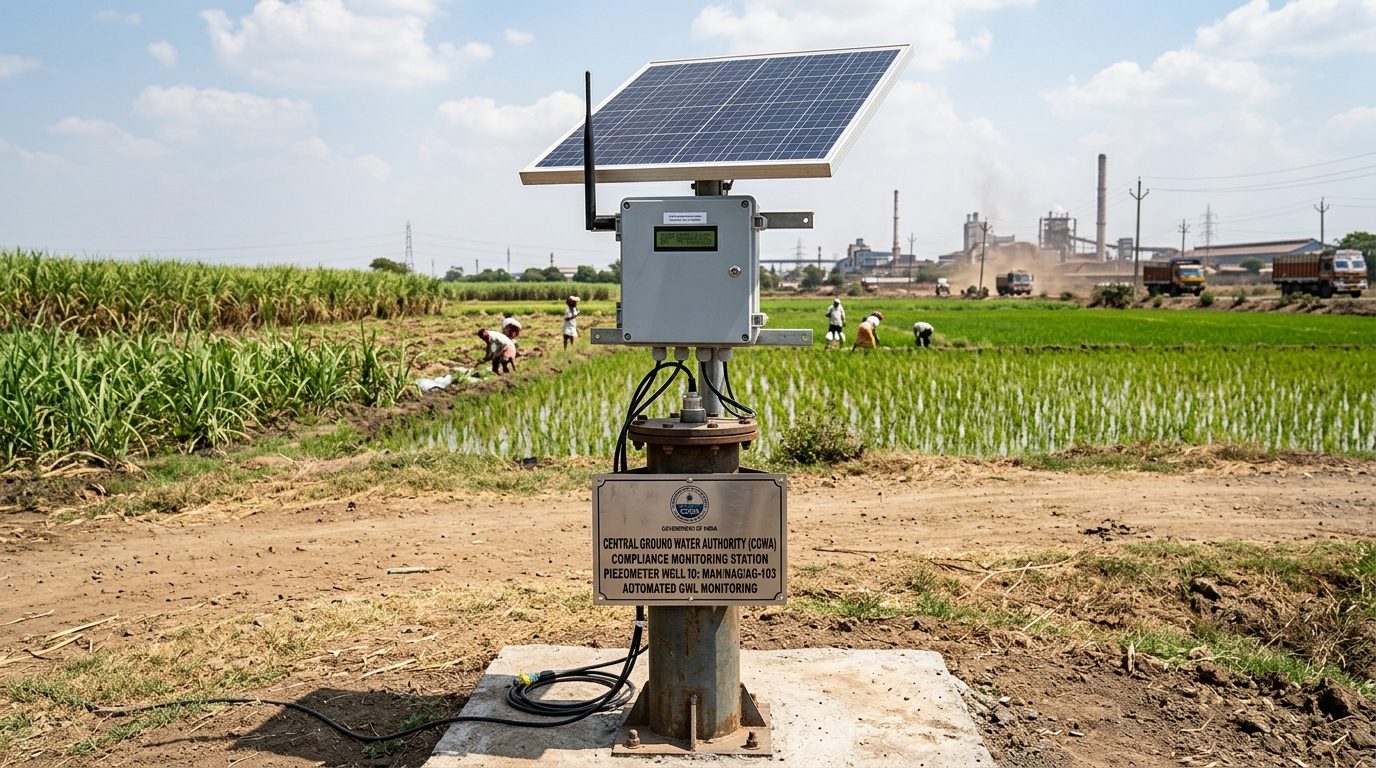
Factories, infrastructure projects and mines that draw groundwater need an NOC from the Central Ground Water Authority (CGWA), or from the state authority where one is notified. Under the CGWA Guidelines, 2020, NOC holders must fit tamper-proof digital water flow meters with telemetry on their abstraction structures, build piezometers to watch the water table, and, above set limits, carry out water audits. Our guide to CGWA groundwater telemetry covers the thresholds in detail.
How it works
How does an OCEMS work, from sensor to CPCB server?
An OCEMS is a measurement chain. A weak link anywhere, from where the probe sits to the internet connection, shows up as bad data or a data gap on the board's screen.
- Sampling pointAnalysers sit at the final outlet after all treatment, in a channel or sampling chamber with steady, well-mixed flow and no dilution. For stacks, the port is placed on a straight run of duct.
- Analysers and flow meterpH, multi-parameter BOD, COD and TSS analysers and a flow meter measure continuously. Stack analysers measure dust and gases.
- Data acquisition systemA data logger collects each signal, stamps it with time and instrument status, and stores it so nothing is lost during a network outage.
- ConnectivityData is pushed over GSM, broadband or leased line to the CPCB and SPCB servers in the format the board specifies, without passing through any editable spreadsheet.
- Calibration and validationAnalysers are calibrated at installation, checked routinely with standards, and verified against parallel samples tested in an accredited laboratory.
- Alerts and recordsExceedance alerts go to the unit and the board; the plant team uses the same data to correct the treatment process before a breach.
| Stream | Core parameters | Often added for some sectors |
|---|---|---|
| Effluent outlet | pH, BOD, COD, TSS, flow | Ammoniacal nitrogen, chromium (tanneries), colour, TDS, temperature |
| Stack emissions | Particulate matter (PM), SO2, NOx | CO, HCl, Cl2, NH3, fluoride, opacity |
| Ambient air (where directed) | PM10, PM2.5, SO2, NO2 | CO, O3, sector-specific gases |
We take parallel samples at your outlet and test BOD, COD, TSS and pH in our NABL-accredited laboratory, then correct the analyser's calibration so your online data holds up in an audit.
Analysers
Which analysers and meters suit your site?
Analyser choice decides how much maintenance the system needs and how well its readings agree with laboratory results.
| Instrument | How it measures | Best for | Watch-outs |
|---|---|---|---|
| UV-Vis spectrophotometer probe | Shines ultraviolet and visible light through the water and relates the absorption spectrum to COD, BOD and TSS | Most effluent outlets; no reagents; measures every few minutes | Needs site-specific calibration against lab results; window fouling causes drift; auto-cleaning is essential |
| Wet-chemistry COD analyser | Digests a sample with reagents, as in the lab method | Effluents where optical methods correlate poorly | Reagent cost and hazardous waste; slower cycle; more upkeep |
| pH and temperature sensor | Glass electrode with temperature compensation | Every outlet | Electrodes age and coat; buffer checks needed often |
| Electromagnetic flow meter | Measures velocity of a conductive liquid in a full pipe | Pumped outlets and borewell delivery lines | Pipe must run full; needs straight lengths before and after |
| Open-channel ultrasonic meter | Measures level over a flume or weir and converts it to flow | Gravity outlets in open channels | Flume must be built and levelled correctly; foam affects readings |
| Stack PM monitor | Light scattering, opacity or beta attenuation | Boiler, furnace and kiln stacks | Needs isokinetic reference tests to calibrate |
| Stack gas analyser (SO2, NOx) | Extractive or in-situ, using NDIR, UV or chemiluminescence | Fuel-burning and process stacks | Sample line condensation; span gas checks |
| Piezometer with DWLR | Pressure transducer in an observation well logs water level | CGWA water level monitoring | Transducer must sit below the lowest expected level; battery and SIM upkeep |
Choose instruments that meet the CPCB OCEMS guidelines for your parameter and are accepted by your SPCB. Cheap analysers that cannot be calibrated to your effluent create more trouble than they save. More detail in our OCEMS compliance checklist.
Rules
What do CPCB and CGWA actually require?
The main requirements, in plain terms. Thresholds and penalties are revised from time to time, so always check your own consent, NOC and the latest notification.
| Requirement | What it means for you |
|---|---|
| CPCB OCEMS directions (2014) and guidelines | Install analysers for the parameters in your consent, connect them to CPCB and SPCB servers, and keep them calibrated |
| Analyser accuracy | Commonly cited tolerances: COD, BOD and TSS within ±10% of lab values; pH within ±0.2 units |
| Calibration | At installation, routine in-house checks (commonly monthly), and periodic performance verification against an accredited laboratory |
| Data availability | Keep data flowing; at least 85% monthly availability is the commonly cited benchmark |
| CGWA Guidelines, 2020: flow meters | Tamper-proof digital water flow meter with telemetry on every abstraction structure of an NOC holder |
| CGWA piezometers | Observation wells for users drawing 10 m³/day or more; DWLR with telemetry on at least one piezometer for larger withdrawals (500 m³/day and above, as commonly read) |
| CGWA water audit | Industries drawing 100 m³/day or more carry out water audits and work towards reducing groundwater use |
| Environment (Protection) Rules, 1986 | The discharge and emission limits your monitored values are compared against |
Cost
How much does OCEMS and CGWA telemetry cost?
Cost depends on the number of outlets, stacks and borewells, the parameters in your consent, and how far the instruments are from power and network.
| System | What it usually includes | Indicative cost* |
|---|---|---|
| Effluent OCEMS, one outlet | pH, BOD/COD/TSS analyser, flow meter, data logger, shelter and connectivity | ₹10 to ₹25 lakh |
| Full OCEMS, effluent plus stacks | Effluent outlet plus PM, SO2 and NOx on one or more stacks | ₹25 to ₹50 lakh and above |
| CGWA flow meter with telemetry | Electromagnetic meter, telemetry unit and portal set-up, per borewell | ₹50,000 to ₹2 lakh |
| Piezometer with DWLR and telemetry | Drilling, casing, recorder and telemetry, per piezometer | ₹1.5 to ₹4 lakh |
| Annual maintenance contract | Servicing, calibration, spares and uptime monitoring | Typically a percentage of system cost per year |
*Indicative 2026 ranges for planning only, excluding civil work, taxes and any changes to the treatment plant itself. Drilling depth and analyser brand change the price a lot. We quote after a site survey and a look at your consent and NOC conditions.
What drives capital cost
- Number of outlets, stacks and borewells
- Parameters listed in your consent
- Optical vs wet-chemistry analysers
- Shelter, power backup and cabling distance
- Piezometer depth and drilling conditions
What drives running cost
- Calibration and lab cross-checks
- Reagents and spares for analysers
- Sensor replacement (pH electrodes, lamps)
- SIM and data charges
- Site visits after alarms
Where money is usually wasted
- Analysers bought without a site calibration plan
- Probes placed where effluent is not mixed
- No power backup, so data drops in outages
- No AMC, so faults sit for weeks
- Separate vendors for meters, loggers and lab
We supply and install CGWA-compliant flow meters and piezometers with telemetry, and support NOC documentation and water audit reports.
Troubleshooting
Common OCEMS and telemetry failures, and how we fix them.
- 01The problem
Sensor fouling: COD or TSS readings creep up because slime, oil or scale coats the optical window.
What we doFit automatic air or brush cleaning, move the probe to a better-mixed point, and set a cleaning schedule matched to your effluent.
- 02The problem
Calibration drift: online values no longer agree with laboratory results, and false exceedance alerts go to the board.
What we doRun parallel samples through our NABL-accredited lab, rebuild the site-specific calibration, and document it for the board.
- 03The problem
Data gaps and server disconnection: the CPCB or SPCB portal shows the station offline.
What we doAdd UPS backup, dual network paths and logger buffering, test the server link, and monitor uptime so faults are fixed in days, not weeks.
- 04The problem
Flow readings are wrong because the pipe runs part-full or the flume was built off-level.
What we doRe-site or re-select the meter, correct the flume, and verify flow with a portable reference meter.
- 05The problem
Groundwater NOC conditions call for meters and piezometers that were never installed.
What we doSupply tamper-proof digital flow meters with telemetry, construct piezometers with DWLR, and set up portal reporting.
- 06The problem
Operators dose chemicals by hand and by guess, so the outlet swings.
What we doLink PLC control and automatic dosing to live readings, with alarms and interlocks, and supply treatment chemicals tested on your effluent.
Sectors and services
What we deliver, and for whom.
Monitoring is only useful if the plant behind it works. These services are designed to be taken together or on their own.
OCEMS for effluent and emissions
Continuous analysers for pH, COD, BOD, TSS and flow, and stack PM, SO2 and NOx, with a live link to CPCB and SPCB servers.
OCEMS checklist →CGWA groundwater compliance
Digital flow meters with telemetry, piezometers with DWLR and NOC documentation support.
CGWA guide →SCADA and PLC control
PLC panels, HMI screens, automatic chemical dosing, alarms and interlocks for ETPs and STPs.
ETP solutions →Smart metering and leak detection
Zone meters, night-flow analysis and water balance reports for campuses, hotels and industrial parks.
Hotels and campuses →Dashboards and alerts
Web and mobile dashboards, SMS and email alerts, and monthly compliance reports in one view.
Plants we monitor →Calibration and AMC
Calibration with lab verification, spares, sensor replacement and annual maintenance contracts.
Our laboratory →Sectors we serve include the 17 highly polluting categories such as pharmaceuticals, distilleries, sugar and textiles, plus CETPs, groundwater users with a CGWA NOC, municipal utilities, industrial parks and dairies.
Buying guide
What to ask before you buy an OCEMS or telemetry system.
Use this list with any supplier, including us.
- Does the system cover every parameter in my consent? Effluent, stacks and any sector-specific additions.
- Is the analyser accepted by my SPCB and does it meet CPCB guidelines? Ask for the documents.
- How will it be calibrated to my effluent? Parallel lab samples, not only factory calibration.
- Who connects it to the CPCB and SPCB servers? And who fixes it when the station shows offline.
- What happens in a power or network outage? UPS, logger buffering and backfill of data.
- Is the CGWA flow meter tamper-proof with telemetry? And will the supplier set up portal reporting.
- What does the AMC cover and what is the response time? Spares, reagents, visits and uptime reports.
- Who verifies accuracy each year? A NABL-accredited laboratory report carries weight with the board.
Why Rispri
Instruments, lab and plant knowledge in one team.
Our own NABL lab
We cross-check your online readings against accredited lab results, so calibration is evidence, not opinion.
Engineering since 1999
1,498+ plants and turnkey projects, so we can fix the treatment plant behind a failing reading, not just the sensor.
Compliance built in
We plan for OCEMS, CGWA and reuse rules from the first drawing, against CPCB and SPCB limits.
We stay after handover
Calibration, spares, AMC and uptime monitoring keep your station on line.
Questions
OCEMS and CGWA telemetry FAQs.
What is OCEMS?
OCEMS stands for online continuous effluent (or emission) monitoring system. It is a set of analysers on a factory's effluent outlet or stack that measures pollutants continuously and sends the data directly to CPCB and SPCB servers, so the board can see compliance in near real time.
Which industries must install OCEMS?
Units in the 17 categories of highly polluting industries, such as distilleries, sugar, textiles, pulp and paper, tanneries, pharmaceuticals, cement, power and steel, along with CETPs and common waste treatment facilities. SPCBs can also direct other units to install it through their consent conditions.
What parameters does OCEMS monitor?
Effluent systems typically measure pH, BOD, COD, TSS and flow, with extras such as ammonia or chromium for some sectors. Stack systems measure particulate matter, SO2 and NOx, and sector-specific gases where required. Your consent order lists the exact parameters.
How does OCEMS measure BOD and COD online?
Most systems use a UV-Vis spectrophotometer probe that reads how the effluent absorbs light and converts the spectrum to COD, BOD and TSS using a calibration built for your effluent. Some sites use wet-chemistry analysers that digest samples with reagents.
How much does OCEMS installation cost?
As an indication, an effluent OCEMS for one outlet costs about ₹10 to ₹25 lakh, and a full system with stacks ₹25 to ₹50 lakh or more, excluding civil work and taxes. The number of outlets and parameters drives the price, so we quote after a site survey.
How often must OCEMS analysers be calibrated?
They are calibrated at installation, checked routinely in-house (commonly monthly), and verified periodically against results from an accredited laboratory. Calibration should be repeated whenever readings drift from lab values or after sensor replacement.
What happens if OCEMS data stops reaching the CPCB server?
The station shows as offline on the board's portal, and long or repeated gaps are treated as non-compliance even if the effluent was fine. Boards can issue notices or levy environmental compensation, so connectivity needs power backup, data buffering and quick repair.
Can existing analysers be connected to the CPCB server?
Often yes. We check whether the analyser meets the guidelines, add a compliant data logger and test connectivity. If an instrument cannot meet the requirements, we recommend a replacement.
What does CGWA require for groundwater monitoring?
Under the CGWA Guidelines, 2020, NOC holders must fit tamper-proof digital flow meters with telemetry on their borewells and build piezometers to monitor water levels. Larger users need digital water level recorders with telemetry and water audits. The exact obligations depend on how much you draw.
What is a piezometer and why does CGWA ask for one?
A piezometer is an observation well, separate from your pumping borewell, used only to measure the groundwater level. CGWA uses the readings to see how your pumping affects the local water table.
Is a water audit mandatory under CGWA?
Industries drawing larger volumes of groundwater, commonly 100 m³/day or more, must carry out water audits and work to reduce groundwater use. Your NOC states the condition that applies to you.
Do you offer AMC for OCEMS and telemetry?
Yes. Our annual maintenance contracts cover servicing, calibration with lab verification, spares, sensor replacement and uptime monitoring, for systems we install and for many systems installed by others.
Related