
SOLUTIONS / WASTE-TO-ENERGY AND BIOGAS
Biogas and Bio-CNG plants
that turn organic waste into income.
We design, build and run biogas and compressed biogas (CBG) plants that turn press mud, food waste, cattle dung, distillery spent wash and crop residue into fuel and fertiliser. Every project starts with a methane-potential test of your own feedstock, because gas yield decides whether the plant pays back.
In short
What a biogas and Bio-CNG plant does.
A biogas plant is a sealed tank, called a digester, in which bacteria break down organic waste without air and release biogas: about 50 to 65% methane, with the rest mostly carbon dioxide and a little hydrogen sulphide. A Bio-CNG or compressed biogas (CBG) plant goes further: it cleans the biogas to above 90% methane (our membrane plants deliver 96%+), compresses it to about 250 bar and sells it as vehicle or piped gas. In India, oil marketing companies buy CBG under the SATAT scheme, and the leftover digestate is sold as fermented organic manure (FOM).
- 96%+
- Methane purity from our multi-stage membrane upgrading
- 5,000plants
- CBG plants targeted under the SATAT scheme
- 1 to 5%
- Mandatory CBG blending in CNG and PNG, FY 2025-26 to FY 2028-29
- ₹1,500/t
- Market development assistance for fermented organic manure
The basics
How does anaerobic digestion make gas from waste?
Anaerobic digestion is the breakdown of organic matter by bacteria in the absence of oxygen. It is the same process that happens in a cow's stomach or at the bottom of a pond, done in a controlled, closed tank. It happens in four steps, carried out by different groups of microbes working together:
- Hydrolysis: large molecules such as starch, fats, proteins and cellulose are broken into sugars, fatty acids and amino acids.
- Acidogenesis: these are fermented into volatile fatty acids (VFA), alcohols, hydrogen and carbon dioxide.
- Acetogenesis: the acids are turned into acetic acid.
- Methanogenesis: methane-forming microbes turn acetic acid and hydrogen into methane and carbon dioxide.
The last group is slow-growing and sensitive. If the feed changes suddenly, acids build up faster than the methane-formers can use them, the pH drops and gas production falls. Most digester failures come down to this one imbalance, which is why feeding discipline and daily lab checks matter more than equipment brand.
Biogas, Bio-CNG and CBG: the difference
Raw biogas is the gas straight out of the digester. It can be burnt in a boiler, a thermic fluid heater or a gas engine for electricity after removing hydrogen sulphide and moisture. Bio-CNG, also called compressed biogas (CBG) or biomethane, is biogas that has been upgraded to remove carbon dioxide, so it behaves like fossil CNG and can run vehicles or be injected into a city gas network. The upgrading and compression stages are what turn a waste-treatment plant into a fuel business.
Why it matters now
India plans thousands of CBG plants, and city gas networks must now blend a rising share of CBG every year. That creates a steady buyer for plants that turn press mud, dung, food waste and crop residue into gas and organic manure. For a sugar mill, distillery, dairy or food factory, the same plant can also solve a waste or effluent problem that the pollution control board is already asking about.
Feedstocks
Which wastes make good biogas?
Gas comes from the volatile solids (VS) in the feed: the part of the dry matter that burns off at 550 °C and is mostly organic. Water and sand make no gas. That is why we always measure total solids (TS), VS and, for liquids, COD before quoting a yield.
| Feedstock | Where it comes from | Gas potential | Watch-outs |
|---|---|---|---|
| Press mud | Sugar mill filter cake, available in the crushing season | Good | Seasonal supply needs storage or co-feed; wax and sand content; fibre slows digestion |
| Food and kitchen waste | Hotels, campuses, canteens, markets, municipal wet waste | High, commonly 100 to 150 m³ biogas per tonne when well segregated | Plastics and cutlery in the feed; fast acid formation can sour the digester if overfed |
| Cattle dung | Dairies, gaushalas, villages | Low per tonne, commonly 30 to 40 m³ biogas per tonne of fresh dung, but very stable | Mostly water and partly digested fibre; sand settles in tanks; best as a stable base for co-digestion |
| Distillery spent wash | Molasses and grain distilleries | High; very high COD | Liquid, so a high-rate reactor is used; high sulphate gives high H₂S; potassium-rich, high-TDS residue |
| Agri residue (paddy straw, napier grass) | Farms, aggregators, energy crops | Medium to good per dry tonne | Lignin slows digestion and needs pre-treatment; bulky collection and storage; fire risk in stock yards |
| Dairy and food effluent sludge | ETP sludge, DAF float, whey | Medium to high (fats give a lot of gas) | Fats cause foaming and scum; whey is very acidic and must be fed gradually |
| Poultry litter | Poultry farms | Good | High nitrogen forms ammonia, which inhibits methane-formers; grit; needs dilution or co-feed |
Yields vary widely with freshness, dilution, contamination and storage. The m³ figures above are typical published ranges for planning only. For any investment decision we run a biochemical methane potential (BMP) test on your own material. For liquid streams a useful check is that each kilogram of COD destroyed can give at most about 0.35 m³ of methane at standard conditions.
Our NABL-accredited laboratory measures total solids, volatile solids, COD, nitrogen, sulphate and other parameters of your feedstock, and our engineers turn the results into a gas and revenue estimate.
How it works
A Bio-CNG plant, stage by stage.
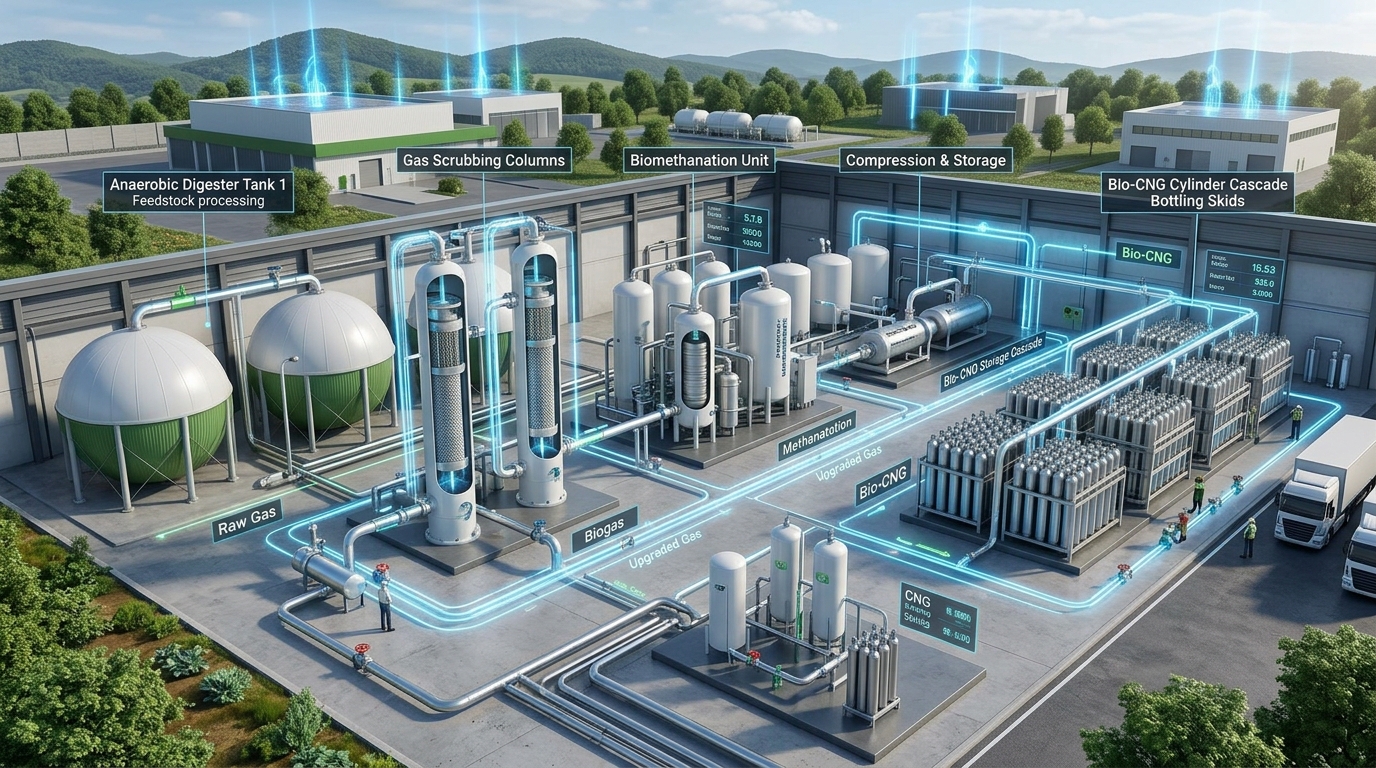
This is the technology stack we build for commercial CBG refineries. A plant that only needs gas for its own boiler stops after stage 4.
| Stage | What happens | Typical equipment |
|---|---|---|
| 1. Receiving and pre-treatment | Feed is weighed, sorted, shredded and mixed to a pumpable slurry. Plastics, sand and stones are removed; straw is chopped and pre-treated. | Feed hopper, shredder, mixing tank, grit trap, hydrolysis tank |
| 2. Anaerobic digestion | Bacteria convert the organic matter into biogas over weeks for solids, or hours for liquid effluent. | Continuous stirred-tank reactors (CSTR), mesophilic or thermophilic, with mechanical agitation and heating; UASB for effluent |
| 3. Gas storage | Gas production rises and falls through the day; a buffer keeps the upgrading plant running steadily. | Double-membrane gas holder with UV-resistant PVC membranes |
| 4. Cleaning | Hydrogen sulphide and moisture are removed to protect equipment and meet the gas specification. | Closed-loop biological scrubber for H₂S and odour, chiller and dryer, activated carbon polish |
| 5. Upgrading | Carbon dioxide is separated so methane rises from about 55% to vehicle grade. | Multi-stage hollow-fibre polyimide membranes (or PSA, water scrubbing or amine), moisture dew-point control |
| 6. Compression and dispatch | Bio-CNG is compressed to about 250 bar and filled into cylinder cascades or a dispenser, or injected into a city gas pipeline. | Multi-stage compressor, 250 bar cascades, dispensers for city gas distribution trucks |
| 7. Digestate to manure | Digested slurry is separated into a solid cake and a liquid, both of which can be sold as fermented organic manure. | Screw press or solid-liquid decanter, drying and enrichment, bagging |
How we deliver, from first sample to steady operation
- 1
Feedstock study
Sampling, lab methane-potential tests and a year-round supply plan.
- 2
Feasibility and DPR
Gas yield, capital and running cost, revenue from gas and manure, payback.
- 3
Design and approvals
Digesters, upgrading, cascades, PESO and SPCB clearances.
- 4
Build and commission
Civil, mechanical and electrical works, start-up and gas testing.
- 5
Operate and improve
Daily process control, lab checks and yield optimisation.
Our research partnership on low-energy gas scrubbing gives existing biogas plants a cheaper way to clean gas before it reaches engines, boilers or upgrading units.
Options
Which digester and which upgrading technology?
Two choices shape the plant: the reactor that makes the gas, and the technology that cleans it. Both depend on your feedstock and on whether you sell the gas or use it yourself.
Digester types
| Digester | Best for | Solids in feed | Watch-outs |
|---|---|---|---|
| CSTR (continuous stirred tank) | Mixed solid feeds: press mud, food waste, dung, straw; most CBG plants | Pumpable slurry, roughly up to 10 to 12% solids | Needs good mixing and heating; long retention means large tanks |
| UASB (upflow anaerobic sludge blanket) | Liquid effluent with high soluble COD: distillery, dairy, food, starch, brewery | Low suspended solids | Fats and solids wash out the granular sludge; slow start-up; needs an aerobic polish to meet discharge limits |
| Plug flow and dry fermentation | Thick, fibrous feeds such as dung with bedding or straw | High solids | Less mixing, so scum and dead zones need managing |
| Covered lagoon | Large volumes of warm, dilute effluent where land is cheap | Low | Large footprint, sludge build-up, less control |
| Floating-drum or fixed-dome household type | Small dairies, gaushalas and kitchens using gas for cooking or heat | Dung or kitchen slurry | Not suited to commercial gas sale |
Biogas upgrading technologies
| Technology | How it works | Best for | Watch-outs |
|---|---|---|---|
| Membrane separation | CO₂ passes through hollow-fibre membranes faster than methane at moderate pressure | Compact, modular plants; easy to expand; our standard choice | Needs dry, H₂S-free gas; single-stage units lose more methane, so we use multi-stage |
| Water scrubbing | CO₂ dissolves in water under pressure; methane does not | Large plants with good water supply | Water and power use; some methane slip; water quality affects performance |
| Pressure swing adsorption (PSA) | CO₂ is held on an adsorbent bed under pressure, then released when pressure drops | Medium plants needing high purity | H₂S and moisture must be removed first; valves cycle constantly |
| Amine scrubbing | A chemical solvent absorbs CO₂; heat regenerates it | Large plants with spare heat; very low methane loss | Needs heat, solvent handling and skilled operators |
Methane lost in the off-gas is lost revenue and a potent greenhouse gas. Always ask a supplier for the guaranteed methane recovery, not only the product purity.
SATAT and rules
Who buys Bio-CNG, and which rules apply?
A CBG plant sells into a regulated fuel market, so the gas, the cylinders and the manure each have their own standard. These are the ones our designs are prepared against.
| Scheme or rule | What it means for your plant |
|---|---|
| SATAT (Sustainable Alternative Towards Affordable Transportation) | Oil marketing companies (IOCL, HPCL, BPCL and others) issue letters of intent to buy CBG from plants at notified prices. Targets: 5,000 CBG plants and 15 million tonnes of CBG a year. |
| CBG Blending Obligation, 2023 | City gas companies must blend CBG into CNG for transport and PNG for homes: 1% in FY 2025-26, rising to 5% by FY 2028-29. |
| IS 16087:2016 | The Indian Standard specification for biogas (biomethane) used in vehicles and piped gas: limits on methane content, CO₂, oxygen, H₂S and moisture. |
| Fertiliser Control Order | Quality norms for fermented organic manure (solid and liquid) made from digestate, so it can be sold. |
| Market development assistance | Support of ₹1,500 per tonne for marketing fermented organic manure. |
| Gas Cylinder Rules, 2016 (PESO) | Approval for cylinder cascades, storage and filling stations from the Petroleum and Explosives Safety Organisation. |
| GOBARdhan portal | Registration of biogas and CBG plants, which unlocks central support schemes. |
| Water Act 1974 and Air Act 1981 | Consent to establish and operate from the State Pollution Control Board, covering effluent, digestate storage, odour and any flare or engine stack. |
Cost and payback
How much does a biogas or Bio-CNG plant cost?
Cost depends far more on the feedstock than on the gas output on paper. Straw needs heavy pre-treatment and storage; spent wash needs a high-rate reactor and effluent polishing; segregated food waste needs neither. These ranges help you budget before we test your material.
| Plant type | Typical use | Indicative plant cost* |
|---|---|---|
| Biogas for own heat or cooking, up to about 1 tonne per day of food waste | Hotels, campuses, canteens, gaushalas | ₹15 to 50 lakh |
| Biogas for boiler or power, 5 to 20 tonnes per day | Food factories, dairies, municipal wet waste | ₹1 to 5 crore |
| Bio-CNG plant, about 1 to 2 tonnes of CBG per day | Small SATAT plants on dung, press mud or food waste | ₹8 to 20 crore |
| Bio-CNG plant, about 5 tonnes of CBG per day | Sugar mills, aggregators, larger cities | ₹25 to 45 crore |
| Bio-CNG plant, 10 tonnes of CBG per day and above | Straw-based and large municipal plants | ₹50 crore upwards |
*Indicative 2026 ranges for planning only: process equipment, upgrading, compression and installation, excluding land, feedstock storage yards, grid or pipeline connection, taxes and working capital. Straw-based plants and spent-wash plants sit at the top of each range. We give a firm price only after testing your feedstock and preparing a DPR. Central financial assistance may be available under national bioenergy schemes; eligibility and amounts change, so we check them at the DPR stage.
What decides payback
- Gas yield per tonne, proved by a BMP test
- Year-round feedstock supply and its price
- CBG offtake price and distance to buyer
- Manure sales, not just manure disposal
- Plant uptime: compressor and upgrading availability
What drives running cost
- Feedstock collection and transport
- Power for mixing, upgrading and compression
- H₂S removal media and chemicals
- Operators and daily lab control
- Membrane, compressor and pump maintenance
Where projects lose money
- Yield taken from a brochure, not a test
- Feed contracts for one season only
- No market for digestate, so it piles up
- Undersized gas cleaning, so compressors corrode
- No buffer storage for feed or gas
How long to payback? For a commercial Bio-CNG plant with a secure feedstock contract, SATAT offtake and fermented organic manure sales, our earlier estimate for a 5-tonne-per-day refinery was full capital payback in about 3.5 to 5 years. This is indicative: it is very sensitive to feed cost, gas price and uptime, which is why we model it in the DPR.
We sample your feedstock, run lab methane-potential tests, plan a year-round supply and prepare a feasibility report and DPR with gas yield, capital and running cost, revenue from gas and manure, and payback.
Troubleshooting
Common biogas plant problems, and how we fix them.
- 01The problem
Gas yield falls below design, or swings from day to day.
What we doTrack VFA, alkalinity and pH daily, correct the feeding rate, and design co-digestion with a stable base feed such as dung so output stays steady through the seasons.
- 02The problem
The digester turns sour: pH drops and gas almost stops.
What we doStop or cut the feed, add alkalinity, recover the biology step by step and set a feeding schedule with clear limits for operators.
- 03The problem
Foaming that blocks gas pipes and overflows the digester.
What we doFind the trigger, usually fats, proteins or sudden overfeeding, then even out the feed, adjust mixing and fit foam detection before the gas line.
- 04The problem
High H₂S: rotten-egg odour, corroded engines and gas rejected by the buyer.
What we doSize H₂S removal for the worst feed, using closed-loop biological scrubbers with a carbon polish, so the outlet meets IS 16087 and the plant runs without nuisance odour.
- 05The problem
Sand, grit and scum fill the digester, cutting its working volume.
What we doAdd grit removal and depackaging at the front end, and plan desludging so it does not need a full shutdown.
- 06The problem
Digestate piles up with no buyer.
What we doSeparate solid and liquid digestate and process it into fermented organic manure tested against the Fertiliser Control Order, so it qualifies for market support.
Where it fits
Built for the sectors that have the feedstock.
Sugar mills and distilleries
Press mud for CBG, and spent wash through a high-rate reactor, often alongside a ZLD system.
ZLD plants →Dairies and gaushalas
Dung, whey and ETP sludge; a UASB ahead of the aerobic ETP cuts power and makes fuel.
Dairy guide →Food processing
Peels, rejects and strong effluent from vegetable, starch and pulse processing.
Pea processing guide →Municipal wet waste
Segregated wet waste from markets and households, alongside composting and recovery.
Waste management →Hotels and campuses
Kitchen waste turned into cooking gas on site, which also meets bulk waste generator duties.
Hotels guide →Agri residue aggregators
Paddy straw and other residue that would otherwise be burnt, turned into CBG and manure.
Biomass pellets →Buying guide
What to ask before you buy a biogas or CBG plant.
Use this list with any supplier, including us.
- Is the gas yield based on a test of my feedstock? A BMP test on representative samples, not a figure from a brochure.
- What happens in the off-season? A written feed plan for all twelve months, with storage and co-feeds.
- What methane purity and recovery are guaranteed? Both, in writing, against IS 16087 and the buyer's terms.
- How is H₂S handled at the worst feed? The design H₂S level and the removal method.
- What is the power use per kg of CBG? Ask for the calculation for upgrading and compression.
- Where does the digestate go? Dewatering, FOM processing and a buyer or land plan.
- Who handles approvals? SATAT LOI, PESO, SPCB consents and GOBARdhan registration.
- Who runs it after start-up? Operator training, daily lab control, spares and an O&M contract.
Why Rispri
One accountable partner, from lab bench to running plant.
Lab and engineering under one roof
Our NABL-accredited laboratory tests your feedstock, sizes the process and verifies the plant after start-up. No hand-offs between vendors.
Engineering since 1999
1,498+ plants and turnkey projects, from compact STPs for hotels to industrial ETP, RO and ZLD systems.
Water side handled too
UASB reactors, effluent treatment and digestate liquor handling are part of the same design, not an afterthought.
We stay after handover
Chemicals, genuine spares, operator training and O&M contracts keep the plant producing for years.
Questions
Biogas and Bio-CNG plant FAQs.
What is a compressed biogas (CBG) plant?
A CBG plant digests organic waste to make biogas, removes the carbon dioxide, hydrogen sulphide and moisture to raise the methane content above 90%, and compresses the gas to about 250 bar. The result, also called Bio-CNG, can be used like fossil CNG in vehicles or city gas networks.
What is the difference between biogas and Bio-CNG?
Biogas is the raw gas from the digester, with roughly 50 to 65% methane and the rest mostly carbon dioxide. Bio-CNG is biogas that has been cleaned and upgraded to vehicle-grade methane and compressed. Biogas suits boilers and gas engines on site; Bio-CNG can be sold as fuel.
What organic feedstocks are suitable for Bio-CNG production?
Press mud from sugar mills, paddy straw and other crop residue, cattle dung, segregated municipal food waste, food processing sludge and distillery spent wash are all used. Most commercial plants co-digest two or more feeds so that gas output stays steady through the year.
How much biogas does one tonne of waste produce?
It depends on the feed. Well-segregated food waste commonly gives about 100 to 150 m³ of biogas per tonne, while fresh cattle dung gives about 30 to 40 m³ per tonne because it is mostly water. We measure your actual yield with a lab methane-potential test before design.
What is the SATAT scheme?
SATAT (Sustainable Alternative Towards Affordable Transportation) is a Government of India initiative under which oil marketing companies buy compressed biogas from plant owners at notified prices. It targets 5,000 CBG plants and 15 million tonnes of CBG a year. Plant owners apply for a letter of intent from an oil company.
What is the Bio-CNG specification in India?
Bio-CNG for vehicles and piped gas must meet IS 16087:2016, which sets minimum methane content and maximum limits for carbon dioxide, oxygen, hydrogen sulphide and moisture. Oil companies test gas against this standard before accepting it.
What is the typical payback for a 5 tonne per day Bio-CNG plant?
With SATAT offtake and sale of fermented organic manure, a well-run commercial plant can indicatively pay back its capital in about 3.5 to 5 years. Payback is very sensitive to feedstock cost, gas price and plant uptime, so we model it for your case in the DPR.
How much does a Bio-CNG plant cost in India?
Indicatively, a Bio-CNG plant of about 5 tonnes of CBG per day costs roughly ₹25 to 45 crore for process equipment and installation, excluding land, storage yards and taxes. Straw-based plants cost more because of pre-treatment and storage. We give a firm price after testing your feedstock.
Can a biogas plant treat industrial effluent?
Yes. For strong, biodegradable effluent such as distillery, dairy or food processing wastewater, a UASB or similar high-rate anaerobic reactor removes most of the COD and produces biogas. It is followed by aerobic treatment so the outlet meets discharge limits.
What is done with the digestate?
Digestate is separated into a solid cake and a liquid. Both can be processed and sold as fermented organic manure meeting the Fertiliser Control Order, and market development assistance of ₹1,500 per tonne supports its sale.
Why does a biogas plant smell, and can it be odour-free?
Odour comes mainly from hydrogen sulphide and from open handling of feed and digestate. Closed receiving areas, closed-loop biological scrubbers and covered digestate storage keep odour to a minimum, which matters for plants near homes.
What approvals does a CBG plant need?
Typically a consent to establish and operate from the State Pollution Control Board, PESO approval for cylinder cascades and filling under the Gas Cylinder Rules, a SATAT letter of intent from an oil company, and registration on the GOBARdhan portal. Local building and fire approvals also apply.
How long does it take to build and start a biogas plant?
Small food-waste plants can be running in a few months. Commercial CBG plants usually take longer for approvals and civil works, and then the digesters need several weeks of gradual feeding before they reach full gas output.
Related